Oscar’s Grind Strategy for Roulette
Di Oscar’s Grind roulette strategy dey raise di stake by one unit afta win, e dey hold am afta loss, and e dey stop each cycle at +1 unit.
E no dey beat di wheel. Oscar’s Grind dey aim to win one unit for each cycle with stakes wey slow and wey dem control. Cycles dey long, drawdownsmoniDrawdownHow much di bankroll fall from im highest point reach one lower point wey come later inside one session. Maximum drawdown na di biggest of dat kind fall.Read di whole tin → no too big, and di expected loss for each unit wey you bet na 2.70%, like for every progression.
Waka through di system
Loss dey keep di stake. Win dey add one unit, but e no go ever pass wetin di cycle need to reach +1. For +1, new cycle dey start.
Stakes and results dey in units of di base bet.
How di Oscar’s Grind roulette system dey work?
Start one cycle with one unitmoniUnitDi base stake wey system or player dey work with. Dem dey describe progressions in units so dat dem go fit work for any table.Read di whole tin →. If you lose, bet di same again. If you win, raise di next bet by one unit, but no ever bet pass wetin go bring di cycle to exactly +1 unit. When di cycle reach +1, start new one with one unit. Di name dey tok true: e dey grind out one unit at a time. Allan Wilson describe am for im Casino Gambler’s Guide for 1965, from one dice player wey e sabi only as Oscar.
How cycle dey look?
L L L W W W: stakes 1, 1, 1, 1, 2, 1. Afta −3 + 1 + 2 = 0, di rule cap di last bet for wetin you need, 1 (no be 3), to reach +1. Results −1 −1 −1 +1 +2 +1 = +1. Di cycle complete afta six spins with three wins and three losses.
How session dey look?
Stakes dey rise only afta wins, so losing run no dey push di stake up. Cycles for losing time just dey long: cycle wey fall reach −8 need plenty wins with stakes wey dey rise to climb comot, and di stakes no dey ever burst. Di result na session wey look like flat bettingstrategyFlat bettingTo bet di same amount every spin. Na di baseline wey dem dey compare every progression with.Read di whole tin → with stake wey dey move up small and long grinding cycles once in a while, and na why dem give am di name.
- p10 −$500
- p25 −$500
- median −$500
- p75 −$500
- p90 −$500
Oscar’s Grind dey work?
No. Each bet dey lose 1/37 of im stake for average, so one cycle dey lose 1/37 of everytin wey you bet inside am. Becos stakes dey stay low for losing runs, di turnovermoniTurnoverDi total moni wey you bet for one session or one period, including winnings wey you bet again. Dem also dey call am: handle, action.Read di whole tin → for each spin pass flat betting only small, and di expected lossmathsExpected lossExpected value times di total moni wey you bet; di average amount wey you go lose for one session or one period.Read di whole tin → for each session pass flat small too. Among di common progressionsstrategyProgressionAny rule wey dey change di stake based on di results wey don pass. Negative progressions dey raise am afta losses, positive ones afta wins.Read di whole tin →, na di one wey near flat betting pass for cost, and dat one na small praise wey correct.
Who dey choose am, and why?
Players wey want structure, wey no like cliffs and wey dey satisfy with +1 unit for each cycle. E no go give di MartingalestrategyMartingaleProgression wey dey double di bet afta every loss. Check di Strategy section to see wetin e dey do and wetin e no dey do.Read di whole tin → feeling of to win most sessions, becos long cycles many times no dey complete inside one session. E no go give di Martingale cliff too.
Simulator · Oscar’s Grind
2,000 sessions of even-money bets from $1,000 bankroll.
Base bet $10 · table limit $500 · 100 spins for each session
Questions wey pipo dey ask
E safe far pass, if you mean sey e no fit bring one single loss wey go scatter you. Di expected loss for each dollar na di same.
For theory. For practice, na your stop rule or your bankrollmoniBankrollDi total moni wey you set aside for play. Bankroll management na to decide how much of am you go risk for each bet and for each session.Read di whole tin → dey end long losing cycle.
One dice player wey Allan Wilson describe for 1965. Nobody sabi anytin more.
Small laugh
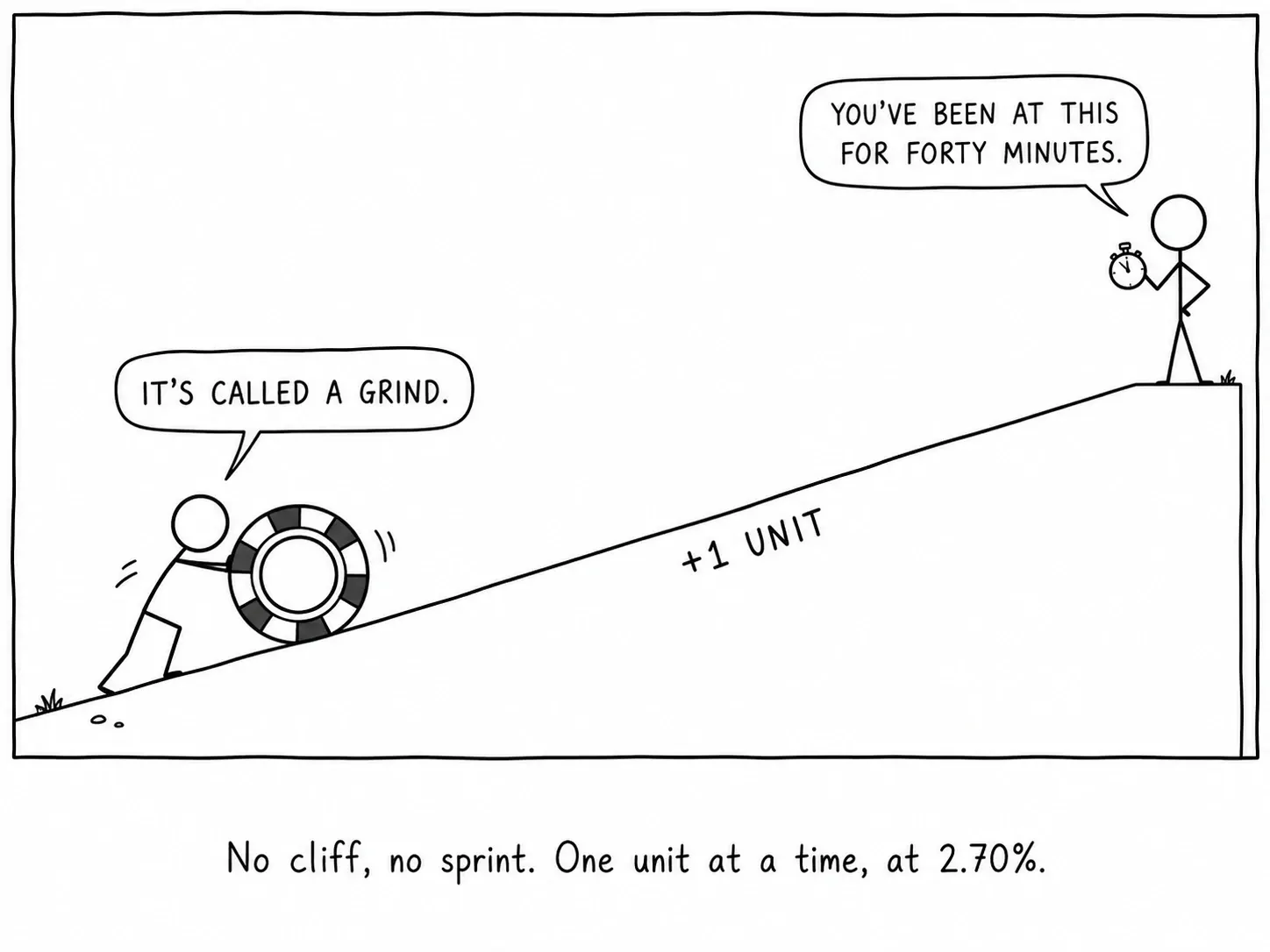
No cliff, no sprint. One unit at a time, for 2.70%.
Sources
- RouletteDoc. How di strategy dey work, with examples.
- Roulette77. How di strategy dey work, with examples.
- Ethier, S. N. The Doctrine of Chances: Probabilistic Aspects of Gambling.
- Epstein, R. A. The Theory of Gambling and Statistical Logic, 2nd ed.