D'Alembert Strategy for Roulette
Di D’Alembert roulette strategy dey add one unit afta loss and remove one afta win.

E no dey beat di wheel. Na di flattest progressionstrategyProgressionAny rule wey dey change di stake based on di results wey don pass. Negative progressions dey raise am afta losses, positive ones afta wins.Read di whole tin → wey pipo dey use: stakes dey move up slowly, drawdowns no too big, and nobody touch di edge.
Waka through di system
Loss dey move one step up. Win dey move one step back.
Stakes and results dey in units of di base bet.
Di D’Alembert roulette system, step by step
Bet one unitmoniUnitDi base stake wey system or player dey work with. Dem dey describe progressions in units so dat dem go fit work for any table.Read di whole tin →. If you lose, di next bet go big pass by one unit. If you win, e go small pass by one unit, but e no go ever go below one. Na all be dat. Picture see-saw: every loss dey push di stake up one notch and every win dey push am back. Di belief wey dey under am na sey wins and losses go balance, so di stake go come back home to di base. Wetin make pipo like am na sey every pair of one win and one loss for stakes wey dey near each oda dey give +1 unit: lose 3, win 4, net +1.
How session dey look?
Gentle, with stake wey dey climb small small. Since losses pass wins 19 to 18 for even money, di stake dey move up over long session. Becos di stake dey highest when you don dey lose, and lower when you dey win, di average stake for di time wey you dey lose pass di average for di time wey you dey win. Sessions smooth pass MartingalestrategyMartingaleProgression wey dey double di bet afta every loss. Check di Strategy section to see wetin e dey do and wetin e no dey do.Read di whole tin →, with drawdownsmoniDrawdownHow much di bankroll fall from im highest point reach one lower point wey come later inside one session. Maximum drawdown na di biggest of dat kind fall.Read di whole tin → wey no too big and no cliff, and dem dey lose small pass flat bettingstrategyFlat bettingTo bet di same amount every spin. Na di baseline wey dem dey compare every progression with.Read di whole tin → for average becos di average stake high pass.
- p10 −$500
- p25 −$500
- median −$500
- p75 −$500
- p90 −$500
Di D’Alembert system dey work?
No. Session wey balance dey win, but sessions no dey stay balanced. Afta w wins and l losses for stakes wey dey near each oda, di net result na w − l units plus correction for where you dey for di ladder. If w = l, di result na exactly +w units, wey look like profit wey sure. Di catch na sey w = l no be wetin you go expect: for 37 spins you go expect 18 wins and 19 losses. One extra loss for stake wey don climb reach, make we say, 8 units cost pass eight of di +1 pairs wey e produce. Di expectation come out to −1/37 of di total turnovermoniTurnoverDi total moni wey you bet for one session or one period, including winnings wey you bet again. Dem also dey call am: handle, action.Read di whole tin →, as e must be.
Why short sessions dey usually win?
Di balanced case na part of one rule wey cover every session. Call D di number of losses minus di number of wins. Session of N spins wey start with one unit go end at (N − D²)/2 − D units, as long as no bet of one unit win (afta win like dat, di stake no get anywhere lower to go). With D = 0 dat one na +N/2, di +w of di section wey dey up. Each extra loss dey count as square: afta 100 spins, D of 4 still leave +38 units, D of 8 leave +10, and D of 10 leave −10. Chance alone dey spread D by about √N, ten afta 100 spins, and for game wey no get zerowheelZeroDi one green pocket wey no even-money, dozen or column bet dey cover; na im be di source of di house edge. Dem also dey call am: single zero, 0.Read di whole tin →, di gains of di many sessions wey balance and di losses of di few wey no balance dey cancel each oda exactly. Di zero dey add one extra loss every 37 spins for average, and becos D dey squared, im cost dey grow fast pass di session. Most sessions of up to 100 spins dey end with profit; di average no dey ever end with profit, and pass few hundred spins, most sessions dey lose too.
Wetin if you turn am round?
Contra-D’Alembert, wey pipo still dey call di reverse D’Alembert, dey add one unit afta win and remove one afta loss. E be exact mirror of di original. As long as no bet of one unit lose, session of N spins go end at (D² − N)/2 + D units, where D now na di wins minus di losses. Session wey balance dey lose half unit for each spin, and na only run of wins wey pass di losses well well go bring profit. So most sessions dey lose small and few dey win plenty, di opposite of di shape of di original, and di average na di same 2.70% of di moni wey you stake.
Who be d’Alembert?
Jean le Rond d’Alembert, mathematician and co-editor of di Encyclopédie, argue for one 1754 article sey afta run of heads, tails go dey more likely. E no correct, and di fallacy wey carry im name na one form of di gambler fallacy. Na later gamblers wey get di same belief name di D’Alembert system for roulette afta am. No be him design am, and e fit be sey e no for support am.

Oda versions dey?
Contra-D’Alembert, wey dey up, dey behave like gentle ParolistrategyParoliPositive progression: double afta you win, start again afta you lose or afta three wins one afta di oda. Dem also dey call am: reverse Martingale.Read di whole tin →. Some players dey add two units afta loss and remove one afta win, and dis one make di ladder steep pass, near Martingale side. All di versions get di same expected lossmathsExpected lossExpected value times di total moni wey you bet; di average amount wey you go lose for one session or one period.Read di whole tin → for each unit wey you bet.
Simulator · D'Alembert
2,000 sessions of even-money bets from $1,000 bankroll.
Base bet $10 · table limit $500 · 100 spins for each session
How often losing streak dey come
Even-money bet for single-zero wheel dey lose 19 spins out of 37. Each row na di chance sey one particular run of spins go lose finish, and how much D’Alembert player, wey dey add one base bet afta every loss, don lose by dat time.
| losses wey follow each oda | chance | about 1 for | wetin you don lose so far | di next bet |
|---|---|---|---|---|
| 1 | 51.4% | 2 | $1 | $2 |
| 2 | 26.4% | 4 | $3 | $3 |
| 3 | 13.5% | 7 | $6 | $4 |
| 4 | 7.0% | 14 | $10 | $5 |
| 5 | 3.6% | 28 | $15 | $6 |
| 6 | 1.8% | 55 | $21 | $7 |
| 7 | 0.94% | 106 | $28 | $8 |
| 8 | 0.48% | 207 | $36 | $9 |
| 9 | 0.25% | 403 | $45 | $10 |
| 10 | 0.13% | 784 | $55 | $11 |
| 11 | 0.065% | 1527 | $66 | $12 |
| 12 | 0.034% | 2974 | $78 | $13 |
| 13 | 0.017% | 5792 | $91 | $14 |
| 14 | 0.0089% | 11279 | $105 | $15 |
| 15 | 0.0046% | 21965 | $120 | $16 |
Di chance na 19/37 wey you multiply by imself once for every loss, counting from one particular spin. Long session get plenty spins where dat kind run fit start, so for one evening e dey happen more often well well pass wetin one row show.
Questions wey pipo dey ask
E no get cliff, and dis one make am di gentlest negative progression. E no cheap pass flat betting; e cost small more.
Only di table limittableTable limitDi minimum and maximum bet wey dem allow. Na di maximum dey stop progressions wey dey double.Read di whole tin → or your bankrollmoniBankrollDi total moni wey you set aside for play. Bankroll management na to decide how much of am you go risk for each bet and for each session.Read di whole tin →. For long losing session, e dey climb steady.
Play with Maths
Try dem by yourself first. Each solution dey folded; open am when you ready.
You play D’Alembert on redbetRedEven-money bet on di 18 red numbers. For French: rouge.Read di whole tin → for 50 spins, you start with one unitmoniUnitDi base stake wey system or player dey work with. Dem dey describe progressions in units so dat dem go fit work for any table.Read di whole tin →, and you no ever win bet of one unit (afta win like dat, di stake no go get anywhere lower to go). You finish with 27 losses and 23 wins. How many units you dey up or down? And with 29 losses and 21 wins?
Show di solution
Answer +13 units with 27 losses, −15 units with 29. Two spins out of fifty wey go di oda way cost 28 units.
Call D di losses minus di wins. Di result na (N − D²)/2 − D for N spins. With 27 losses and 23 wins, D = 4: (50 − 16)/2 − 4 = 17 − 4 = +13. With 29 and 21, D = 8: (50 − 64)/2 − 8 = −7 − 8 = −15.
Why di rule dey work: di stake na always one unit plus di losses so far minus di wins so far. Each loss wey one later win cancel dey make pair, lose s and then win s + 1, wey net +1 unit, as di table wey dey up show. Out of N spins, (N − D)/2 pairs like dat dey form, wey worth +(N − D)/2. Di D losses wey remain, dem put dem for stakes 1, 2 … D as e dey go up and dem no ever cancel; dem cost 1 + 2 + … + D = D(D + 1)/2. Togeda: (N − D)/2 − D(D + 1)/2 = (N − D²)/2 − D.
Di square na di whole story. Session wey balance dey pay half unit for each spin, and every step away from balance dey cost pass di one before.
You play reverse D’Alembert on red for 100 spins, you start with one unit, and no bet of one unit ever lose. You finish with 52 wins and 48 losses. Where you dey? And with 60 wins and 40 losses?
Show di solution
Answer −38 units with 52 wins, +170 with 60. Small lead for wins still dey lose; na only big lead dey pay.
Call D di wins minus di losses. Di result na (D² − N)/2 + D for N spins.
52 wins and 48 losses: D = 4, so (16 − 100)/2 + 4 = −42 + 4 = −38.
60 wins and 40 losses: D = 20, so (400 − 100)/2 + 20 = 150 + 20 = +170.
Why: each win wey one later loss cancel dey make pair, win for s and then lose for s + 1, wey net −1. Di D wins wey remain, dem put dem for stakes 1, 2 … D as e dey go up and dem no ever cancel; dem dey bring D(D + 1)/2. Out of N spins, (N − D)/2 pairs dey form, so di total na D(D + 1)/2 − (N − D)/2 = (D² − N)/2 + D.
Na di rule of di original D’Alembert with di signs wey dem turn round: for there, balance dey win half unit for each spin and imbalance dey suffer; here, balance dey cost half unit for each spin and imbalance dey get reward.
Small laugh
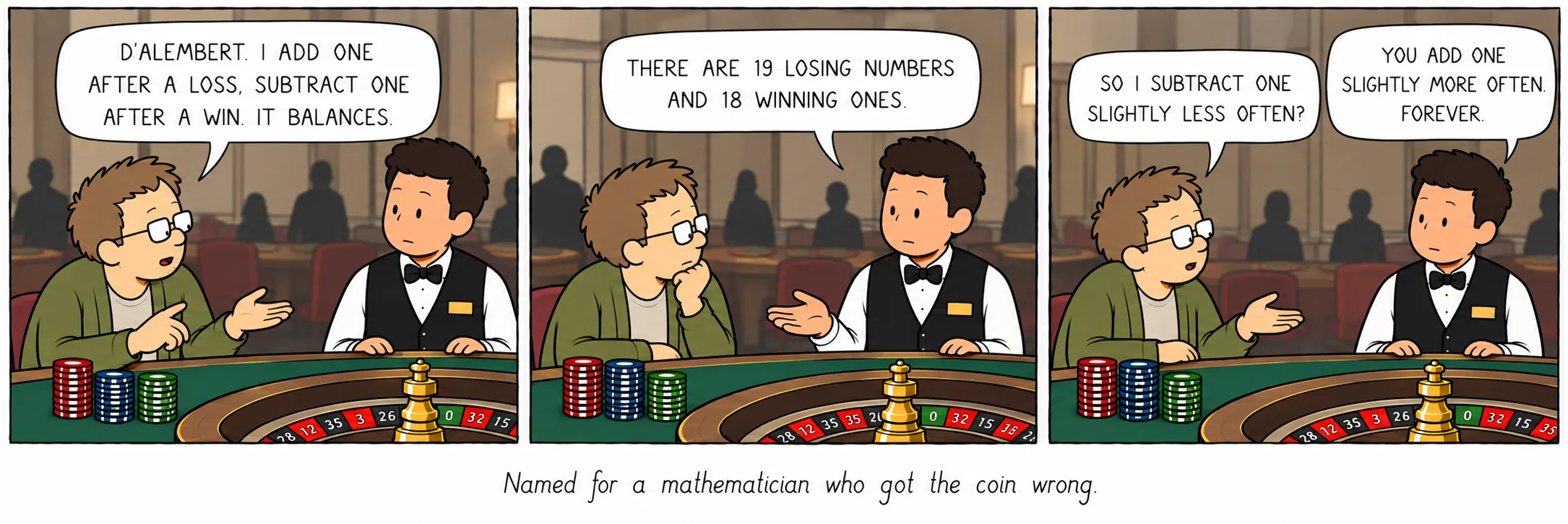
Dem name am afta mathematician wey no get di coin correct.
Sources
- RouletteDoc. How di strategy dey work, with examples.
- Roulette77. How di strategy dey work, with examples.
- d’Alembert, J. “Croix ou pile.”
- Ethier, S. N. The Doctrine of Chances: Probabilistic Aspects of Gambling.
- Epstein, R. A. The Theory of Gambling and Statistical Logic, 2nd ed.