Bias for Roulette Wheel
Biased roulette wheel dey favour some pockets becos of physical fault: fret wey loose, rotor wey no level, pockets wey don wear. Roulette wheel bias dey and pipo don use am before. Di problem be sey wheel wey fair well well dey produce “hot numbers” all di time, so di question no be whether one number dey hot, but whether di whole pattern no balance pass wetin chance fit allow.

1. Sample one fair wheel
Spins from simulated wheel wey no get any bias at all. Change di size of di sample and watch di hottest pocket.
2. Wetin we see vs wetin we expect
Each bar na one pocket for wheel order. Di dashed line na di count wey we expect, n/37. Di shaded band na ±2 standard deviations: for fair wheel, about one pocket out of twenty go comot outside am by chance alone.
3. Di chi-square test
Di test dey add how far every pocket dey from wetin we expect, squared and scaled. For fair wheel, di sum dey follow chi-square distribution with 36 degrees of freedom; p-value wey dey under 0.05, pipo dey normally call am significant.
n = 370 · E = 10.00 · χ² = 32.80 · p = 0.622
4. How many spins you go need
Spins wey you need to find one pocket wey dey hit more often pass 1/37, for one-sided 5% level with 80% power. Pocket wey dey hit 1 time for 35 instead of 1 for 37 go be strong edge for player, and e dey take tens of thousands of spins wey you record to confirm am.

Methodology
Small laugh
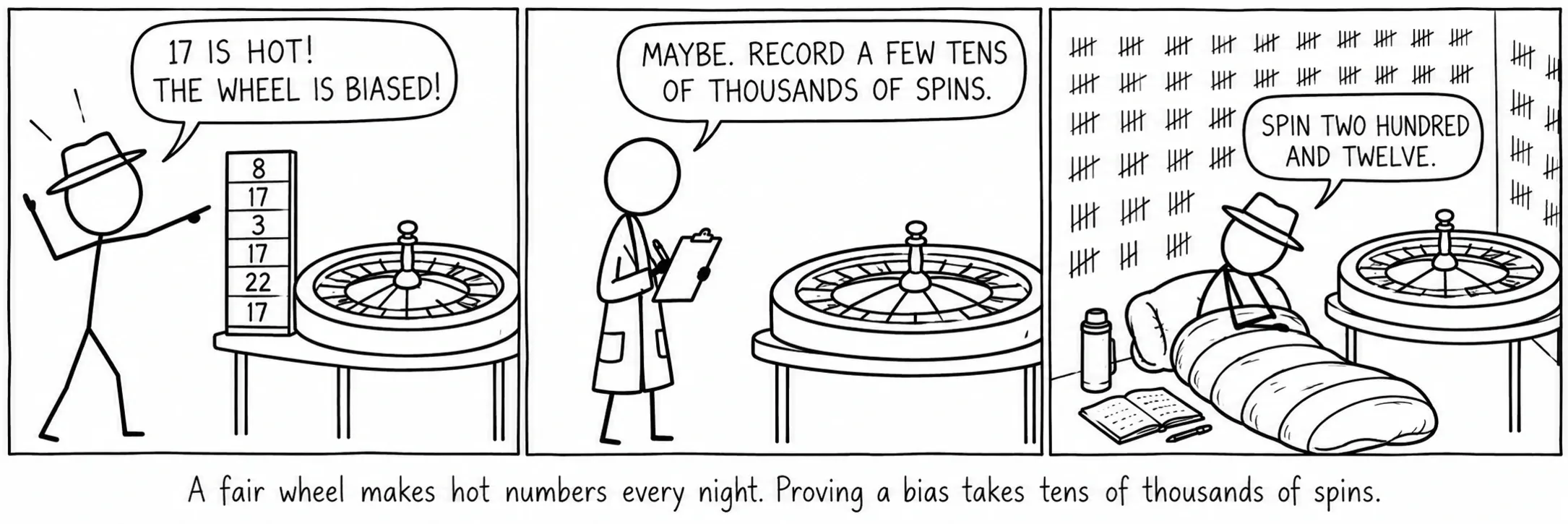
Fair wheel dey make hot numbers every night. To prove bias need tens of thousands of spins.
Sources
- Pearson, K. (1900). On the criterion that a given system of deviations… Philosophical Magazine, 50(302).
- Thorp, E. O. (1969). Optimal gambling systems for favorable games. Review of the International Statistical Institute, 37(3).
- Ethier, S. N. (2010). The Doctrine of Chances: Probabilistic Aspects of Gambling. Springer. Ch. 13, Roulette.