Standard Deviation for Roulette
Roulette standard deviation, di square root of variancemathsVarianceOne measure of how wide di results dey spread around di expected value. E high for straight up, e low for even-money bets.Read di whole tin →, na di usual distance between one result and im expectation.

For every $1 wey you stake, σ na 5.84 for straight up and 1.00 for red. For one session, multiply am by di stake and by di square root of di number of spins.
Simple Rule
About two third of sessions dey land inside one σ of di expectation and 95% inside two. For 100 redbetRedEven-money bet on di 18 red numbers. For French: rouge.Read di whole tin → spins with $10 (expected −$27, σ = $100), most sessions dey fall between −$127 and +$73, and almost all between −$227 and +$173. Result wey dey outside dat range no be evidence of anytin, except sey one session out of twenty dey do am.
Why √N
Expected lossmathsExpected lossExpected value times di total moni wey you bet; di average amount wey you go lose for one session or one period.Read di whole tin → dey grow according to N; di spread dey grow according to √N. For small N, di spread dey dominate and sessions na like coin flip wey lean small. For large N, di loss dey run pass di spread. Di crossover, where expected loss dey equal one standard deviationmathsStandard deviationSquare root of variance; di normal distance between one result and di expected value.Read di whole tin →, dey for N = (σ/edge)² = (1/0.027)² ≈ 1,370 spins for even money and (5.84/0.027)² ≈ 46,800 for straight upsbetStraight upOne single number, e dey pay 35:1.Read di whole tin →. Below dis numbers, na luck dey decide; above dem, na di edge.
How to Use Am
To judge whether one session dey unusual, calculate (result − EV)/σ. Person wey dey bet $10 on red wey finish 100 spins for +$150 dey for (150 + 27)/100 = 1.77σ, outcome wey dey happen one time out of 25: lucky, but e no strange. Person wey dey bet straight up with di same +$150 dey for 0.3σ: normal night. Di same dollar result dey mean different tins for different bets.
Standard Error of Proportion
Di same arithmetic dey tell you how many spins e go take to see di edge for di data. Di standard error of win proportion wey you observe na √(p(1 − p)/N). For red with N = 1,000: √(0.4865 × 0.5135 / 1000) ≈ 1.6%. Di gap between fair coin and red na 1.35%, so afta 1,000 spins you still no fit separate dem with confidence. Afta 10,000, di standard error na 0.5% and you fit. Na also why to detect wheel bias dey need plenty spins.
Warning About Skew
Straight-up results dey far from normal distribution for short session: most sessions na steady −$10 for every spin with +$350 jumps once in a while. Di ±1σ rule dey describe di spread correct but di shape no well until N reach hundreds. For even-money betsbetEven-money betRed/black, odd/even, high/low. 18 numbers, e dey pay 1:1.Read di whole tin →, di normal approximation dey good from about 30 spins.
Formula
Questions wey pipo dey ask
Na proof sey you play about 40 sessions, or sey you dey di one lucky session out of forty. Do am again.
E dey swing less and less: di standard error of di average na σ/√N. By N = 10,000 e don be 1% of di stake.
Play with Maths
Try dem by yourself first. Each solution dey folded; open am when you ready.
For 100 spins of European wheel, one unitmoniUnitDi base stake wey system or player dey work with. Dem dey describe progressions in units so dat dem go fit work for any table.Read di whole tin → on redbetRedEven-money bet on di 18 red numbers. For French: rouge.Read di whole tin → dey ahead with at least 51 wins, and one unit on straight upbetStraight upOne single number, e dey pay 35:1.Read di whole tin → dey ahead if im number hit at least 3 times. Use di bell curve to estimate both chances, then compare dem with di exact answers.
Show di solution
Answer Red: di bell curve dey give 35.6% and di exact answer na 35.5%. Di straight up: di bell curve dey give 55.0% and di exact answer na 50.9%. Di shortcut dey work for red but e miss for di single number.
Red: wins dey average 100 × 18/37 = 48.6, with spread of √(100 × 18/37 × 19/37) = 5.0. Ahead mean 51 or more; di halfway mark, 50.5, dey 0.37 spreads above di average, and di bell curve dey put 35.6% above dat one. If you add di exact chances of 51, 52 … 100 wins, e go give 35.5%.
Straight up: hits dey average 100/37 = 2.70, with spread of √(100 × 1/37 × 36/37) = 1.62. Three hits or more mean above 2.5, 0.12 spreads below di average: 55.0% by di bell curve. Exactly, na 1 minus di chances of 0, 1 and 2 hits, 6.5% + 17.9% + 24.7%, wey leave 50.9%.
Di bell curve need plenty results for both sides of di average. Red get dem afta 100 spins; number wey no dey hit reach three times for average no get am. Di curve even dey give 8.7% to “no hit”, where di true chance na 6.5%. Taylor (2021) put di binomial and di bell curve side by side di same way.
Small laugh
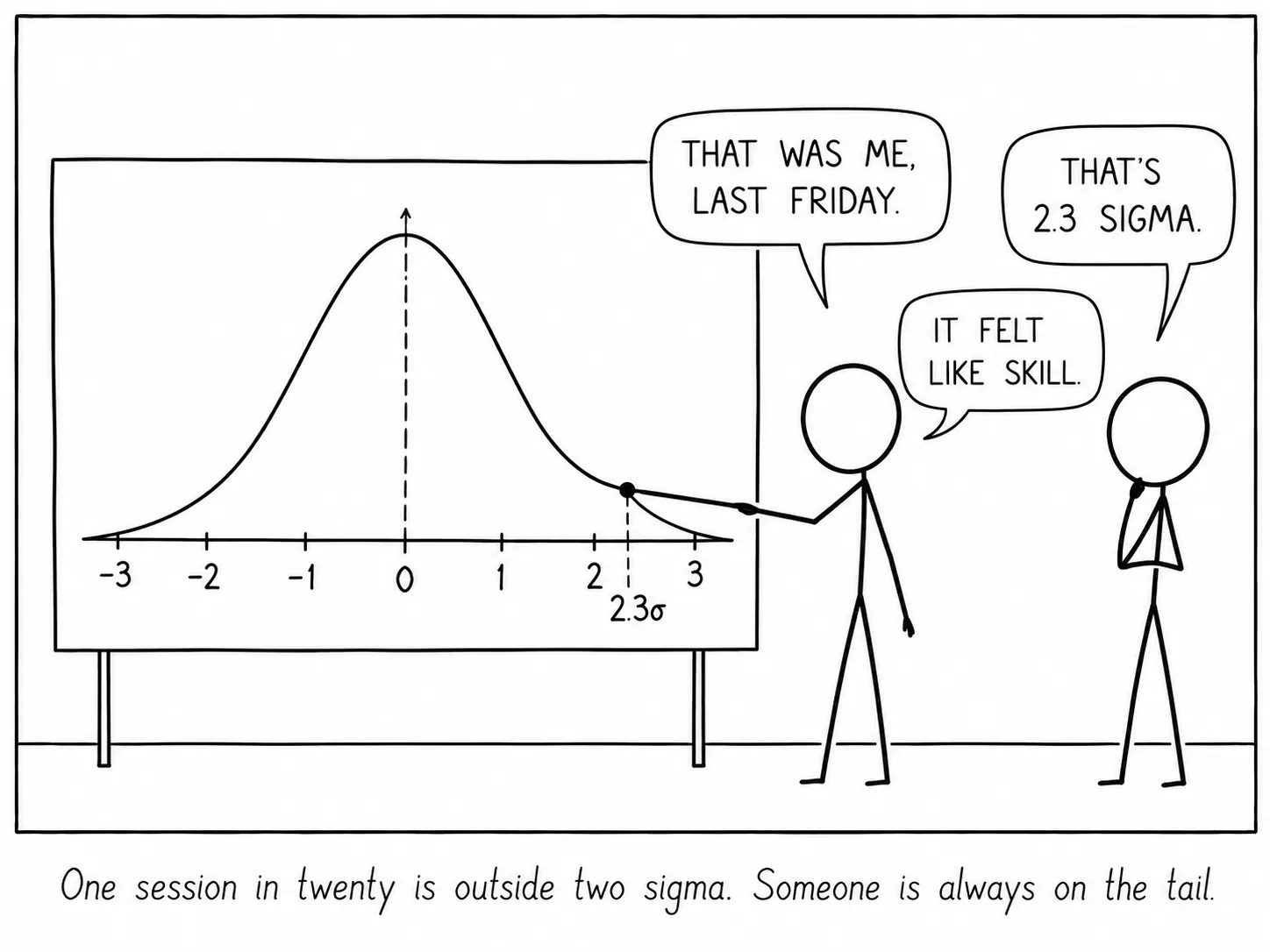
One session out of twenty dey outside two sigma. Somebody dey always dey for di tail.
Sources
- Feller, W. An Introduction to Probability Theory and Its Applications, Vol. 1.
- Ethier, S. N. The Doctrine of Chances: Probabilistic Aspects of Gambling.
- Taylor, D. G. Games, Gambling, and Probability: An Introduction to Mathematics, 2nd ed.