Kelly Criterion and Roulette
Di Kelly criterion dey tell bettor wey get edge how much e go stake. For roulette, e dey give clear answer: notin.

Kelly stake = edge / odds. With negative edge, di formula dey give negative fraction, and dat one mean make you no bet. Di criterion still get use to understand why bias players size dia bets di way wey dem do, and why everybody else suppose size by budget.
Di Criterion
John Kelly (1956) ask how gambler wey get edge wey e sabi suppose size bets to make di bankrollmoniBankrollDi total moni wey you set aside for play. Bankroll management na to decide how much of am you go risk for each bet and for each session.Read di whole tin → grow pass for di long run. Di answer, for bet wey dey pay b to 1 with win probabilitymathsProbabilityDi chance of one outcome, from 0 to 1 or from 0% to 100%. One number: 1/37 = 2.70%.Read di whole tin → p and loss probability q = 1 − p, na to stake di fraction f* = (bp − q) / b of di bankroll. Positive f* mean bet dat fraction; zero or negative mean make you no bet. Kelly work for Bell Labs, and im paper, “A new interpretation of information rate”, put di problem inside di information theory of Claude Shannon: gambler wey dey get tips through line wey get noise, for fair odds, fit grow di bankroll at best for di rate wey di line dey carry information. For 1961, Leo Breiman prove sey Kelly betting, for di long run, dey end ahead of any strategy wey really different, and e dey reach goal wey you set for about di shortest time.

Kelly Betting for Roulette
For redbetRedEven-money bet on di 18 red numbers. For French: rouge.Read di whole tin →: b = 1, p = 18/37, q = 19/37; f* = (18/37 − 19/37)/1 = −1/37. For straight upbetStraight upOne single number, e dey pay 35:1.Read di whole tin →: b = 35, p = 1/37, q = 36/37; f* = (35/37 − 36/37)/35 = −1/1295. Every standard bet dey give negative Kelly fraction, becos every bet get negative edge, and di stake wey go give di best growth na zero. Kelly betting for roulette na formal way to tok wetin di house-edge page tok: no size dey where bet wey get negative expectation go grow bankroll.
Where Kelly Really Apply
Bias players get edge and sizing problem. Jagger, di García-Pelayos and di Eudaemons all must decide how much to bet on di advantage wey dem measure, and if you bet too small you go waste di edge, while if you bet too big you fit ruin before di edge show. For pocketequipmentPocketOne of di 37 small boxes wey get number for di rotor. Dem also dey call am: slot, cup.Read di whole tin → wey dey hit 1 out of 30, Kelly tok 0.57% of bankroll for every spin on dat number: with $10,000, about $57 for every spin, for typical growth of about 0.054% for every spin, or ×1.7 over 1,000 spins. Di average gain na double dat one, 0.11% for every spin, but Kelly dey aim for di typical bankroll, no be di average one, wey few lucky runs dey blow up. Half Kelly na di usual practical choice becos di estimate of di edge no sure.
Typical and Average
Di gap between di typical bankroll and di average one wide. Take pocket wey dey hit 1 time out of 25, edge of 44%, di figure wey Thorp give for im device. Kelly dey stake 1.26% of di bankroll on am. Afta 1,000 spins, di typical bankroll don grow about 11.5 times, while di average, wey few very lucky runs pull up, don grow about 249 times. To bet more pass Kelly dey raise di average and reduce di typical result: for double di Kelly stake, di typical bankroll only double, and by two and half times di Kelly stake e dey shrink, even though every bet still carry 44% edge. To bet less no dey cost much: half di stake dey keep about three quarter of di growth.
When Di Edge Na Guess
Kelly assume sey you sabi di edge. For di table, na estimate, and di estimate dey usually too high. Di example of Epstein, wey build on di 44% of Thorp, na number wey hit 49 times for 1,225 spins of double-zerowheelZeroDi one green pocket wey no even-money, dozen or column bet dey cover; na im be di source of di house edge. Dem also dey call am: single zero, 0.Read di whole tin → wheel: 1 time out of 25, edge of 44%, Kelly stake of 1.26%. But fair double-zero wheel get 38 numbers, and di busiest of dem dey reach 49 or more for 1,225 spins about one time out of nine. Di busiest number for any record na also di one wey luck don help pass, so even pocket wey really get bias dey look better for di record pass how e be: di winner curse. If dat pocket no get bias at all, di Kelly stake na just bet wey dey lose 5.26% for average. Di usual answers na to bet fraction of Kelly and to continue to count until di edge survive one fresh record (see How to Find Bias for Roulette Wheel).
Pipo Wey Get Edge
To sabi di edge no be di same as to use am well. Haghani and Dewey (2016) give 61 pipo $25 each to bet for half hour on coin wey dem tell dem sey dey show heads 60% of di time, with winnings wey dem cap for $250 (players hear about di cap only when dem reach am). Kelly tok make you bet 20% of di bankroll on heads every time, and di authors estimate sey steady bets of 10–20% go reach di cap about 95% of di time. Only 21% of di players reach dia. 28% lose everytin, 18 of di 61 bet everytin on one single flip, about one third finish below di $25 wey dem start with, and di average payoutmoniPayoutWetin bet wey win dey return, wey dem dey quote as “X to 1” on top di stake wey dem return.Read di whole tin → na $91. Only five of di 61 don hear about di Kelly criterion before. With edge, di size of di bets dey decide whether you go keep am; without edge, like for fair wheel, no size fit help.
Wetin to Use Instead
Without edge, sizing na budget question, no be growth question: stake = wetin you dey ready to spend for every spin, wey come from di budget for every hour and di speed of di table (bankroll management page). Wetin Kelly dey give di normal player na di clear answer: zero. Everytin wey you stake above zero na di price to play, wey you choose, no be any formula optimise am.
Note About Fractional Kelly and “Money Management”
Systems wey dem dey sell as “Kelly for roulette” wey dey recommend fixed percentage of bankroll for every bet na flat bettingstrategyFlat bettingTo bet di same amount every spin. Na di baseline wey dem dey compare every progression with.Read di whole tin → with stake wey dey shrink. Dem dey lose 2.70% of turnovermoniTurnoverDi total moni wey you bet for one session or one period, including winnings wey you bet again. Dem also dey call am: handle, action.Read di whole tin → and, becos di stake dey shrink as you dey lose, dem dey make ruin slow instead of unlikely. Na reasonable way to make budget last; e no be Kelly, wey go tell you make you stop.
Formula
Questions wey pipo dey ask
Only with edge wey you measure from biased wheellabBiased wheelWheel wey get physical defect wey make some pockets come out pass 1/37. E rare, and you fit only find am with thousands of spins wey you record.Read di whole tin → or timing device. No be for fair wheel.
Becos di estimate of di edge get error, and to bet too big dey cost more pass to bet too small. Half Kelly dey give three quarter of di growth for one quarter of di variancemathsVarianceOne measure of how wide di results dey spread around di expected value. E high for straight up, e low for even-money bets.Read di whole tin →.
No. Kelly dey optimise growth when edge dey. Bankroll management dey control spending when no edge dey.
Play with Maths
Try dem by yourself first. Each solution dey folded; open am when you ready.
Di prediction device of Thorp and Shannon give about 44% edge. For one number wey dem predict, Kelly tok sey make you bet 1.26% of di bankrollmoniBankrollDi total moni wey you set aside for play. Bankroll management na to decide how much of am you go risk for each bet and for each session.Read di whole tin →. Wetin if di same 44% edge come for one bet wey dem spread over five numbers wey dey near each oda?
Show di solution
Answer Then Kelly go tok 7.1% of di bankroll, and di bankroll go grow almost six times as fast: about 1.25 million times for 1,000 bets, against about 11.5 times.
Straight upbetStraight upOne single number, e dey pay 35:1.Read di whole tin → wey get 44% edge dey win with chance 0.04, since 36 × 0.04 = 1.44. Di Kelly stake na di edge divided by di odds: 0.44/35 = 1.26%. Di normal growth for each bet na 0.04 × ln(1 + 35 × 0.0126) + 0.96 × ln(1 − 0.0126) ≈ 0.00244, so 1,000 bets dey multiply di bankroll by about e^2.44 ≈ 11.5.
Spread one stake over five numbers and di bet go win with chance 0.20 and pay 36/5 for 1, wey be 6.2 to 1: e still be 44% edge, since 0.2 × 7.2 = 1.44. Di Kelly stake go become 0.44/6.2 = 7.10%, and di growth for each bet 0.01404, about 5.75 times as much. For 1,000 bets na e^14.04, about 1.25 million.
Di edge na di same; di swings dey smaller. Bet wey dey win one time for five fit carry bigger share of di bankroll without risk of ruin, and di growth of Kelly dey reward dat one. Thorp (1984) use di example to show why prediction players dey bet sectorswheelSectorPockets wey follow each oda for one arc of di wheel, no be group for di layout.Read di whole tin →. For real life, five neighboursbetNeighboursOne number and di two pockets for each side of am for di wheel, five straight-up chips.Read di whole tin → dey carry edge wey low small pass di single best number (see Advantage Play for Roulette).
One player don find two pocketsequipmentPocketOne of di 37 small boxes wey get number for di rotor. Dem also dey call am: slot, cup.Read di whole tin → wey dey near each oda, wey each one dey hit 1 time for 25 instead of 1 for 37. E suppose bet di splitbetSplitTwo numbers wey dey near each oda, e dey pay 17:1.Read di whole tin → between dem for 17 to 1, or each number straight up? How much Kelly tok, and how fast di bankroll go grow compared with one pocket like dat?
Show di solution
Answer E no make any difference: 2.59% of di bankroll on di split, or 1.29% on each number. Di normal bankroll dey grow about 155 times for 1,000 spins, against 11.5 times with one pocket.
Di split dey win with probabilitymathsProbabilityDi chance of one outcome, from 0 to 1 or from 0% to 100%. One number: 1/37 = 2.70%.Read di whole tin → 2/25 = 0.08 and e dey pay 17 to 1, so e dey return 18 × 0.08 = 1.44 for each unitmoniUnitDi base stake wey system or player dey work with. Dem dey describe progressions in units so dat dem go fit work for any table.Read di whole tin → wey you stake: edge of 44%, di same as one biased pocket. Di Kelly stake na di edge divided by di odds: 0.44/17 = 2.59%.
Two straight-up bets of 1.29% each dey give exactly di same results. When any of di two numbers come out, one chipmoniChipToken wey stand for one fixed amount, wey you put on top di layout to make bet. Dem also dey call am: check.Read di whole tin → dey win 35 to 1 and di oda one dey lose, net of 34 × 1.29% = 44% of di bankroll, like di split dey pay; when no one come out, both dey lose.
Di growth for each spin na 0.00505, against 0.00244 for one pocket, so for 1,000 spins di normal bankroll dey grow e^5.046 ≈ 155 times instead of e^2.44 ≈ 11.5 times. Two good numbers worth pass two times one well well, and na why bias players dey bet groups of numbers. Thorp (1984) work di same comparison.
Small laugh
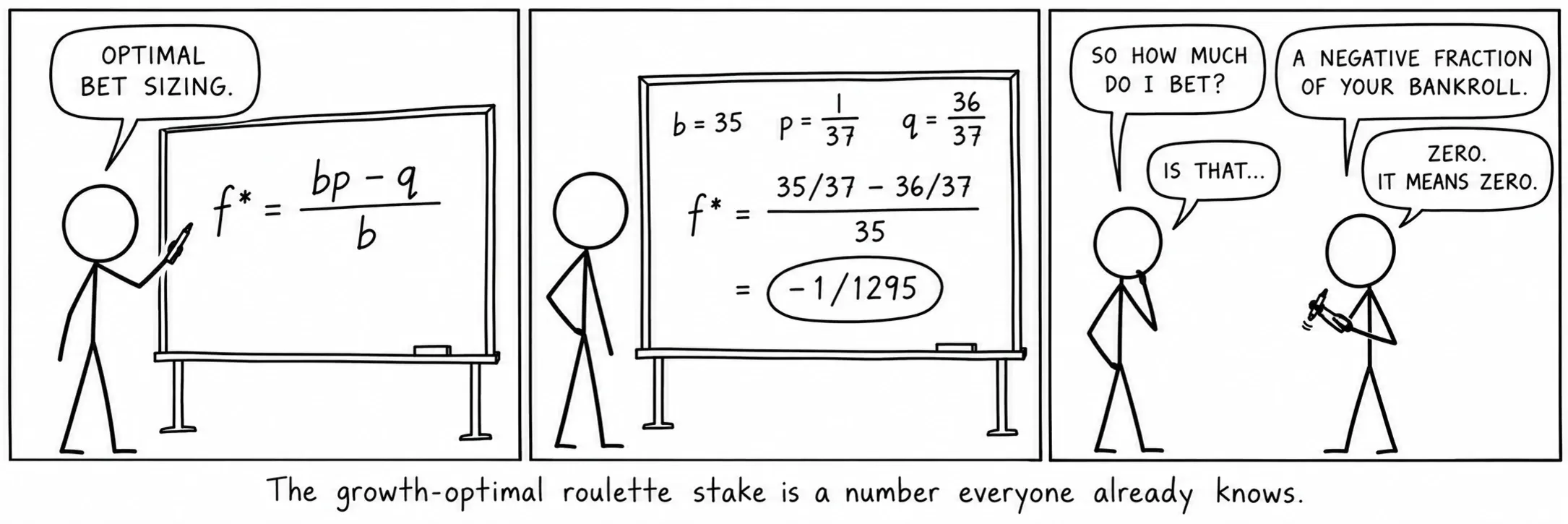
Di roulette stake wey go give di best growth na number wey everybody don already sabi.
Sources
- Kelly, J. L. “A new interpretation of information rate.”
- Breiman, L. “Optimal gambling systems for favorable games.”
- Thorp, E. O. “Optimal gambling systems for favorable games.”
- Thorp, E. O. The Mathematics of Gambling.
- Epstein, R. A. The Theory of Gambling and Statistical Logic, 2nd ed.
- Taylor, D. G. Games, Gambling, and Probability: An Introduction to Mathematics, 2nd ed.
- Ethier, S. N. The Doctrine of Chances: Probabilistic Aspects of Gambling.
- Haghani, V. & Dewey, R. “Rational decision-making under uncertainty: observed betting patterns on a biased coin.”