Problem: Di Table Limit
$10 Martingale for $500 table. How often e dey break, how much e dey lose when e break, and to raise di limit dey help?
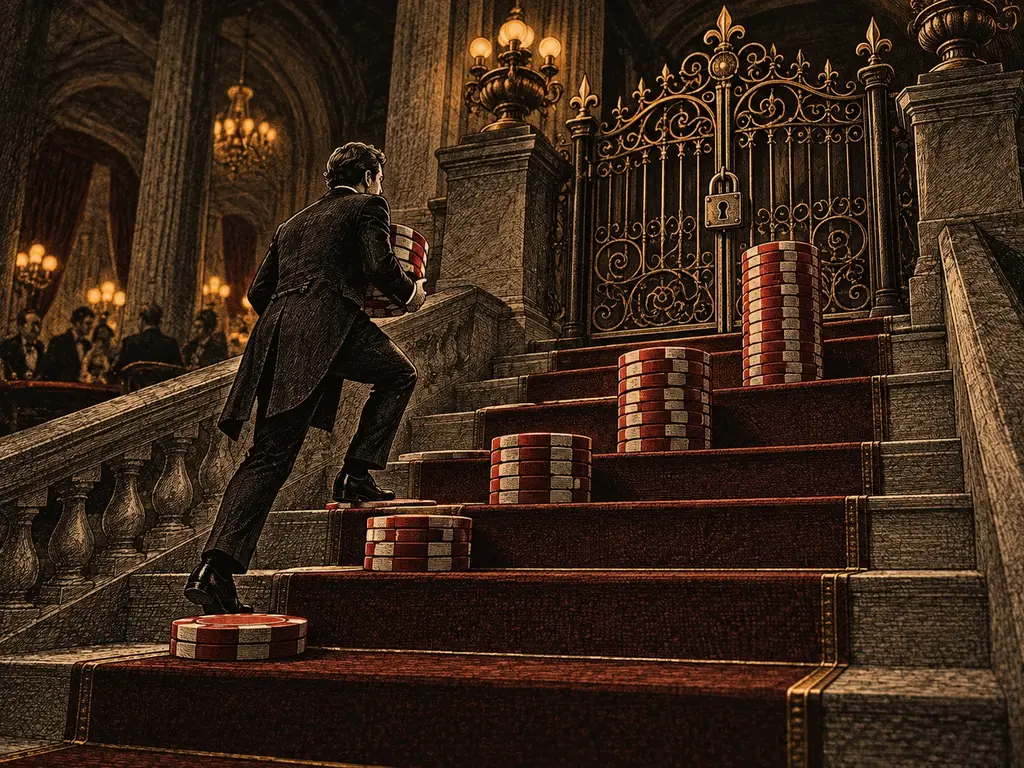
Six losses one afta di oda dey break am: 1.8% for every cycle, about 60% of sessions of 100 spins. Di break dey cost $630. To raise di limit to $5,000 dey make di break rare pass (0.25% for every cycle) and big pass ($5,110). Di expected loss for every dollar wey you bet na 2.70% for any limit.
Di Problem
One player dey bet $10 on redbetRedEven-money bet on di 18 red numbers. For French: rouge.Read di whole tin → and e dey double afta every loss, and go back to di start afta win. Di table maximum na $500. (a) How many losses one afta di oda go break di progressionstrategyProgressionAny rule wey dey change di stake based on di results wey don pass. Negative progressions dey raise am afta losses, positive ones afta wins.Read di whole tin →? (b) Wetin be di probabilitymathsProbabilityDi chance of one outcome, from 0 to 1 or from 0% to 100%. One number: 1/37 = 2.70%.Read di whole tin → for every cycle? (c) Wetin go lose when e break? (d) How $5,000 limit go change di answers? (e) Any limit dey wey go make di system bring profit?
Answers (a)–(c)
Stakes: 10, 20, 40, 80, 160, 320. Di seventh go be 640 > 500, so six losses go break am. (b) p(loss) = 19/37 on red; (19/37)⁶ = 0.0183, about 1.8% for every cycle. One cycle dey last about two spins for average, so session of 100 spins get about 50 cycles and p(at least one break) ≈ 1 − 0.9817⁵⁰ ≈ 60%. (c) 10 + 20 + 40 + 80 + 160 + 320 = $630, wey be 63 base unitsmoniUnitDi base stake wey system or player dey work with. Dem dey describe progressions in units so dat dem go fit work for any table.Read di whole tin →, against di $10 wey di cycle dey try win.
Answer (d)
For $5,000: dem allow stakes reach 2,560; dem go refuse di tenth stake, 5,120. Nine losses go break am: (19/37)⁹ ≈ 0.25% for every cycle, about 11% of sessions of 100 spins. Loss when e break: 10 + 20 + … + 2,560 = $5,110. Di player don buy catastrophe wey rare pass, for di price of one wey big pass. Over many sessions, di expected cost of breaks na p × loss ≈ 0.0183 × 630 = $11.5 for every cycle for di $500 limit and 0.0025 × 5,110 = $12.8 for $5,000; di two dey close but dem no equal, and each one na di expected lossmathsExpected lossExpected value times di total moni wey you bet; di average amount wey you go lose for one session or one period.Read di whole tin → of di cycle plus di $10 wey di winning cycles dey earn.
Answer (e)
No. Expected loss for every cycle = (di total stake wey we expect for di cycle) / 37, for any limit, becos every bet na −1/37 of imself. Di limit only dey decide how di loss go share between plenty small wins and few big losses. With no limit and bankrollmoniBankrollDi total moni wey you set aside for play. Bankroll management na to decide how much of am you go risk for each bet and for each session.Read di whole tin → wey no get end, di progression go “work”, as e no go ever break, and e go also bet amount wey no get end with expected loss of 2.70% of dat amount wey no get end. No be di table limittableTable limitDi minimum and maximum bet wey dem allow. Na di maximum dey stop progressions wey dey double.Read di whole tin → dey stop MartingalestrategyMartingaleProgression wey dey double di bet afta every loss. Check di Strategy section to see wetin e dey do and wetin e no dey do.Read di whole tin → from working. Na arithmetic.
Two Real Tables
Di example of Thorp na $1 table with $1,000 maximum, where one player dey hope to win $30 for dinner, one dollar at a time. Di stakes 1, 2, 4 … 512 dey allow ten bets, so ten losses one afta di oda go break di progression: once for 785 cycles for European wheel (once for 613 for American one), and e go cost $1,023. Thirty cycles go all succeed 96.2% of di time. Di oda 3.8% dey lose about $1,000, and di average result of di evening na −$9.17, wey be exactly 1/37 of di $339 wey di thirty cycles dey stake for average. $5 table with $2,000 maximum no different: stakes reach $1,280 dey allow nine bets, and di break dey come once for 403 cycles for European wheel (once for 323 for American one) and e dey cost $2,555.

One Rich Player
Give di progression deep bankroll instead of low limit: 1,000 units, base of one unit and 1,000 spins on red, and start again from one unit anytime di next double pass wetin remain. We simulate one million of dis kind evenings. For European wheel, 52% dey finish ahead, 21% dey lose everytin, and di average result na −124 units. Even for game wey no get zerowheelZeroDi one green pocket wey no even-money, dozen or column bet dey cover; na im be di source of di house edge. Dem also dey call am: single zero, 0.Read di whole tin →, where every bet fair, only about 60% go finish ahead. Di usual evening na small win; na di evenings wey end for zero dey pay for di average.
Di Lesson
Casinos dey set limits to cap dia own variancemathsVarianceOne measure of how wide di results dey spread around di expected value. E high for straight up, e low for even-money bets.Read di whole tin →, no be to defeat systems. To defeat Martingale na side effect wey dem happy to get, and di arithmetic go defeat am anyway. Player wey think sey di limit na di problem don find di cliff and e mistake am for di slope.
Formula
Questions wey pipo dey ask
E go make you survive reach higher limit, where di break rare pass and big pass. Di expected loss for every dollar no change.
Stakes 10, 30, 70, 150, 310: di $500 limit go reach afta five losses, and di break go cost $570. Di same 2.70%.
So dat one player no go fit bet more pass wetin di reserve of di casino fit pay well. Variance management.
Play with Maths
Try dem by yourself first. Each solution dey folded; open am when you ready.
One MartingalestrategyMartingaleProgression wey dey double di bet afta every loss. Check di Strategy section to see wetin e dey do and wetin e no dey do.Read di whole tin → dey start with $100 on redbetRedEven-money bet on di 18 red numbers. For French: rouge.Read di whole tin → and e allow imself at most n bets for each cycle: afta n losses wey follow each oda, e go give up and start again. Write di average result of one cycle as formula for n, and work am out for 5, 6 and 7 bets for European wheel.
Show di solution
Answer Di average na 100 × (1 − (38/37)ⁿ): −$14.26 for 5 bets, −$17.35 for 6 and −$20.52 for 7. To allow more bets dey make di average cycle worse, e no dey make am better.
One cycle dey win $100 unless all di n bets lose, wey dey happen with chance qⁿ, where q = 19/37. When all of dem lose, di stakes 100, 200 … 100 × 2ⁿ⁻¹ dey add up to 100 × (2ⁿ − 1). So di average na 100 × (1 − qⁿ) − 100 × (2ⁿ − 1) × qⁿ = 100 × (1 − (2q)ⁿ).
Here 2q = 38/37, wey pass 1 small, so (2q)ⁿ dey grow with n and di average dey fall: n = 5 dey give 1.1426 and −$14.26; n = 6 dey give 1.1735 and −$17.35; n = 7 dey give 1.2052 and −$20.52. Longer ladder dey lose less often, for 3.6%, 1.8% and 0.9% of cycles, but each loss dey two times bigger, and more moni dey cross di table for each cycle, for 2.70% of every bet.
For American wheel 2q = 40/38 and di figures na −$29.24, −$36.04 and −$43.20 (Taylor, 2021). For game wey no get zerowheelZeroDi one green pocket wey no even-money, dozen or column bet dey cover; na im be di source of di house edge. Dem also dey call am: single zero, 0.Read di whole tin →, 2q = 1, and every cycle dey average exactly zero no matter how long di ladder be.
Di “grand Martingale” dey double di stake afta loss and add one unitmoniUnitDi base stake wey system or player dey work with. Dem dey describe progressions in units so dat dem go fit work for any table.Read di whole tin →, so di stakes dey go 1, 3, 7, 15, 31 … How much you dey up when di first win come for di 1st, 2nd, 3rd or kth bet? With $10 unit and $500 maximum, how often one cycle dey break, and how much one cycle dey cost for average?
Show di solution
Answer Win for di kth bet dey leave you k units up: +1, +2, +3 and so on. For $10 and $500, di cycle dey break afta five losses, 3.57% of cycles, for −$570. For average, one cycle dey lose $2.32 out of $85.73 wey you stake: 2.70%.
Di kth stake na 2ᵏ − 1 units: 1, 3, 7, 15, 31. Di first k − 1 stakes dey add up to 2ᵏ − 2 − (k − 1) = 2ᵏ − k − 1. Win for di kth bet dey pay 2ᵏ − 1, so di cycle dey end (2ᵏ − 1) − (2ᵏ − k − 1) = k units up: one extra unit for every loss before di win.
For $10 for each unit, di stakes na $10, $30, $70, $150 and $310; di next one, $630, pass di $500 maximum. Five losses wey follow each oda, (19/37)⁵ = 3.57%, dey cost 10 + 30 + 70 + 150 + 310 = $570.
Average: di wins dey bring $10 × k with chance (19/37)ᵏ⁻¹ × 18/37 for k = 1 reach 5, and di break dey carry $570 with chance 3.57%; togeda −$2.32. Di moni wey you stake dey average $85.73 for each cycle, and 2.32/85.73 = 2.70%. Di normal Martingale for di same table dey break afta six losses, 1.83% of cycles, for −$630, and e dey lose $1.74 out of $64.20 wey you stake: 2.70% again.
One player dey plan Martingale on red with $1 first bet for table wey im limit na $1,000, so ten bets fit happen: $1, $2, $4 and so on reach $512. How often one cycle dey lose all ten, how long dat one dey take for average, and how often evening of 200 bets dey end like dat?
Show di solution
Answer One cycle dey lose all ten about once for 784, and e dey cost $1,023. Dat na about 1,600 bets for average, and evening of 200 bets dey hit di wall about 11% of di time. One cycle still dey lose $0.31 for average out of $11.31 wey you stake: 2.70%.
Bet on red dey lose with chance 19/37, zero inside. Ten wey follow each oda: (19/37)¹⁰ ≈ 0.00128, about 1 for 784. Di stakes 1 + 2 + 4 + … + 512 dey add up to $1,023.
One cycle dey take 2.05 bets for average, so 784 cycles dey take about 1,600 bets. If you count spin by spin, run of ten losses dey show somewhere for 200 bets 11.3% of di time.
Between di disasters, di player dey win $1 for each cycle: about $783 before di bad one, then −$1,023, about −$240 for di whole stretch. For each cycle: 1 × (1 − 0.00128) − 1,023 × 0.00128 ≈ −$0.31. Moni wey you stake for each cycle: 1 + 2 × (19/37) + 4 × (19/37)² + … + 512 × (19/37)⁹ ≈ $11.31. And −0.31/11.31 = −2.70%.
Compare $10 first bet for $500 limit, six bets: di wall dey come once for 55 cycles, and evening of 200 bets dey meet am 84% of di time. Higher limit dey make di crash rare pass and big pass, e no dey make am cheap.
Small laugh
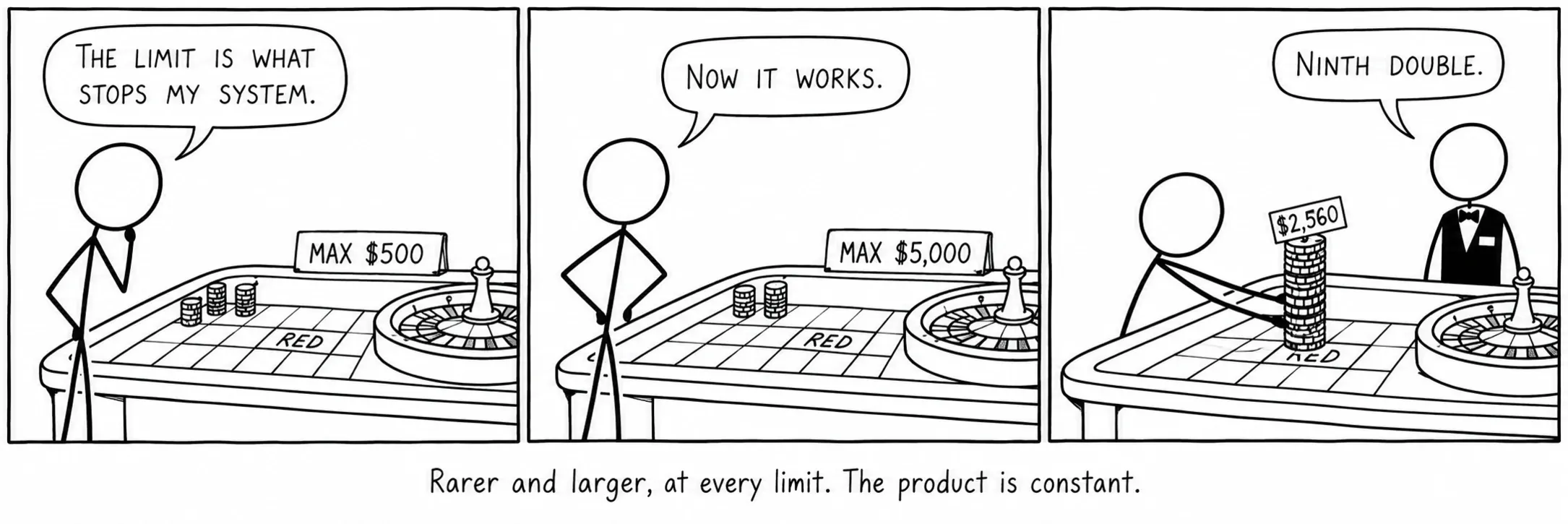
Rare pass and big pass, for every limit. Di product no dey change.
Sources
- Ethier, S. N. The Doctrine of Chances: Probabilistic Aspects of Gambling.
- Thorp, E. O. “Optimal gambling systems for favorable games.”
- Thorp, E. O. The Mathematics of Gambling.
- Epstein, R. A. The Theory of Gambling and Statistical Logic, 2nd ed.