Risk of Ruin
Di probability sey you go lose your whole bankroll before you reach one target.

For even-money bets, risk of ruin dey follow di gambler ruin formula. With $500 bankroll, $10 bets and $600 target, you go reach di target about 57% of di time and lose everytin di rest of di time.
Di Question
You get a unitsmoniUnitDi base stake wey system or player dey work with. Dem dey describe progressions in units so dat dem go fit work for any table.Read di whole tin → of bankrollmoniBankrollDi total moni wey you set aside for play. Bankroll management na to decide how much of am you go risk for each bet and for each session.Read di whole tin → (di total moni wey you set aside for play) and you want reach a + b units, as you dey bet one unit at a time on even-money betbetEven-money betRed/black, odd/even, high/low. 18 numbers, e dey pay 1:1.Read di whole tin → wey get win probabilitymathsProbabilityDi chance of one outcome, from 0 to 1 or from 0% to 100%. One number: 1/37 = 2.70%.Read di whole tin → p = 18/37 and loss probability q = 19/37. Wetin be di chance sey you go reach di target before you reach zero? Pascal, Fermat and Huygens work di answer out for di 1650s, and e be one of di oldest results for probability.
Di Gambler Ruin Formula
P(reach target) = (1 − (q/p)ᵃ) / (1 − (q/p)ᵃ⁺ᵇ). Risk of ruinmathsRisk of ruinDi probability sey you go lose di whole bankroll before you reach one target or one number of spins.Read di whole tin →, di chance sey you go lose di whole bankroll, na one minus dat one. With q/p = 19/18 ≈ 1.0556, di ratio dey grow exponentially with di number of units, so di formula dey punish small units well well: di more bets e take to reach di target, di more times you go pay di 2.70% toll for di way.
How to Read Am
Smaller units dey pain. To try double $500 with $10 bets dey succeed 6% of di time; with one single $500 bet e dey succeed 48.6% of di time. Bold play, fewer and bigger bets, dey give di highest chance to hit target for game wey get negative expectation, becos e dey reduce di number of times wey di edge dey apply. E also dey give di highest variancemathsVarianceOne measure of how wide di results dey spread around di expected value. E high for straight up, e low for even-money bets.Read di whole tin → for wetin go happen to you, and e dey end di evening quick. Di theorem name na “bold play na di best way”, and Dubins and Savage prove am for 1965.
Where Di Problem Start
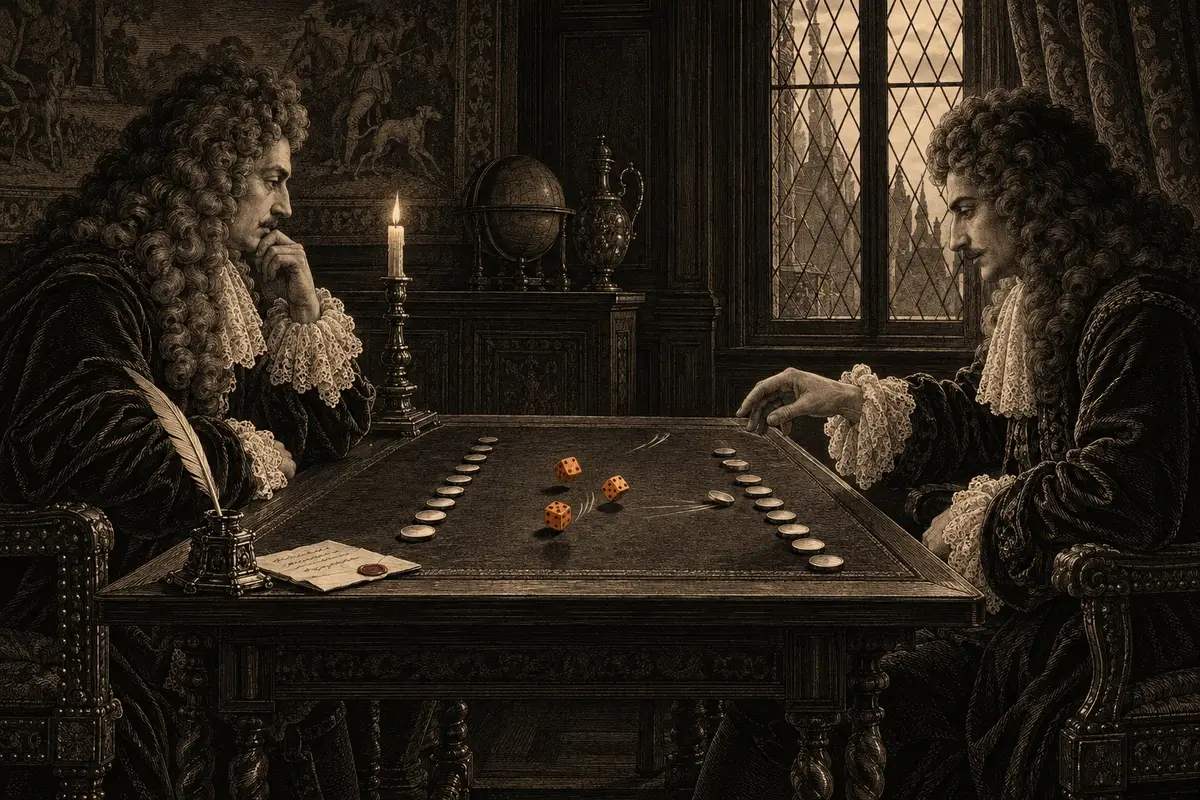
Di question old pass roulette. For 1656, Pascal give Fermat one puzzle: two players dey throw three dice, each one start with 12 counters; throw of 11 dey move one counter one way, throw of 14 dey move am di oda way. Both of dem solve am, and Huygens, wey hear about am through one letter from di mathematician Pierre de Carcavi, print am for 1657 as di fifth problem of di first book on probability, with di answer and no proof. Eleven fit come out 27 ways and fourteen only 15, so every counter dey move to di first player side 9 times out of 14, and di formula above, with 12 counters each, dey make am about 1,157 times more likely to win everytin pass to lose everytin. 2.70% edge small well well pass dat one, but di same formula dey show wetin e dey do over many bets.
One Real Bold Bet
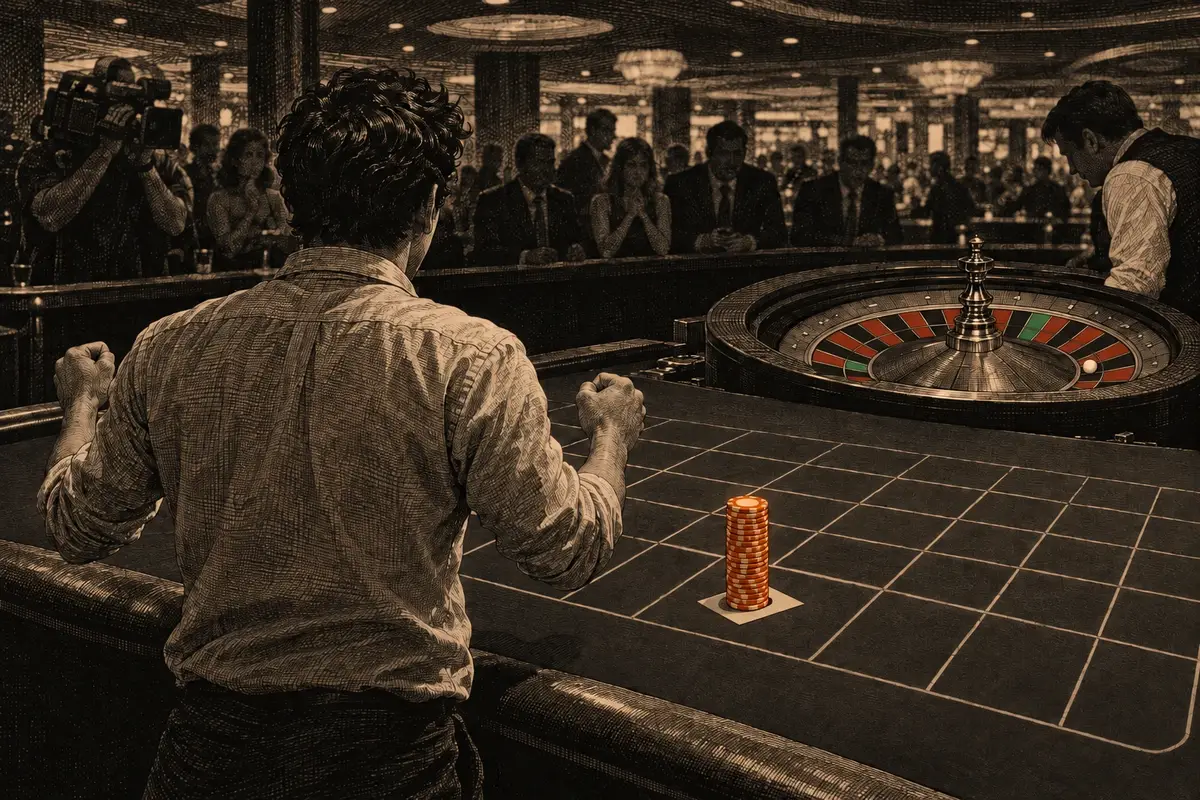
For April 2004, Ashley Revell, one young Englishman, sell almost everytin wey e get, including im clothes, and carry $135,300 go di Plaza for Las Vegas. Afta some small bets, e put di whole amount on redbetRedEven-money bet on di 18 red numbers. For French: rouge.Read di whole tin →, one time. Di ballequipmentBallDi small ball wey dem dey throw for di track against di rotor. Modern balls na ivorine or Teflon, 18–21 mm.Read di whole tin → land for red 7 and e waka comot with $270,600. For double-zerowheelZeroDi one green pocket wey no even-money, dozen or column bet dey cover; na im be di source of di house edge. Dem also dey call am: single zero, 0.Read di whole tin → wheel, dat single spin na 47.37% chance and e cost am $7,121 for average, di 5.26% edge for one bet. If e spread am over $10 bets, di same target for almost no get hope. Bold play no dey make di bet good; e dey make am short as e fit be.
Risk of Ruin Without Target
If you just dey play until you lose everytin or you stop afta N spins, di question go become “wetin be di chance sey my bankroll go touch zero inside N spins?”. No closed form dey for general N, but di simulators for dis site dey calculate am: $500 bankroll with $10 on red almost never finish inside 100 spins (under 1%), e dey finish about 9% of di time inside 500 spins, and about 95% of di time inside 5,000. Without stop rule, di probability dey go towards 100%, and dat one na di long-run version of di house edgemathsHouse edgeDi part of each stake wey di casino dey keep for average: 2.70% for European roulette.Read di whole tin →.
- p10 −$500
- p25 −$500
- median −$500
- p75 +$0
- p90 +$350
Wetin Happen for Long Run: Law of Large Numbers for Roulette
How Long, and How Far Ahead
Two more classical results dey answer questions wey players dey really ask. Without target, flat even-money bets dey last for average 37 spins for every unit of bankroll for European wheel and 19 for American one, becos every spin dey carry 1/37 of one unit for average (1/19 for American wheel): 100 units dey last 3,700 spins for average, even though half of dat kind sessions dey finish inside 3,134 (see How Long Session Dey Last and Wetin E Cost). And no matter how big di bankroll be, di chance for European wheel to ever dey k units ahead na (18/19)ᵏ. Dat one na 95% for one unit and 58% for ten, but no bankroll, no matter how deep, fit give even chance to ever dey 13 units up; for American wheel di chance na (9/10)ᵏ and e dey drop below one half for 7 units.
How Long Session Dey Last and Wetin E CostAmerican Roulette: Di Wheel and Di Rules
Bankroll for Fifty-Fifty Chance
Turn di question round: how much you must bring to get at least fifty-fifty chance to win one particular amount before you lose everytin? For small win, no be plenty. For bigger one, di bankroll wey you need dey climb well well, and afta one point no bankroll go reach, becos even bankroll wey no get end dey give chance wey small pass fifty-fifty to ever reach dat far ahead. Taylor (2021) put am anoda way: for American wheel, to get fifty-fifty chance to reach 100 units, you must start with 94, to risk 94 to win 6. For European wheel you go need 88.
Di Practical Lesson
Decide wetin you dey try do. If di goal na one particular win, bet big and few. If di goal na long evening, bet small and accept sey di edge go take im 2.70% of big turnovermoniTurnoverDi total moni wey you bet for one session or one period, including winnings wey you bet again. Dem also dey call am: handle, action.Read di whole tin →. If di goal na both, one tin must give way, and na usually di target.
Formula
Questions wey pipo dey ask
MartingalestrategyMartingaleProgression wey dey double di bet afta every loss. Check di Strategy section to see wetin e dey do and wetin e no dey do.Read di whole tin → dey reduce am for short sessions and e dey raise am well well for long ones. Flat bettingstrategyFlat bettingTo bet di same amount every spin. Na di baseline wey dem dey compare every progression with.Read di whole tin → with bigger unit na di honest way to reduce am.
Di formula above na for even money. For high-variance bets, ruin dey more likely for small stakes and you go reach di target in a rougher way; use di calculator.
Every step towards di target dey small less likely pass every step towards ruin; di ratio dey compound over di number of steps.
Play with Maths
Try dem by yourself first. Each solution dey folded; open am when you ready.
You get $100 and you wan reach $1,000, and you go bet only on redbetRedEven-money bet on di 18 red numbers. For French: rouge.Read di whole tin →. Plan one: bet $1 at a time. Plan two: bet everytin wey you get until you pass $500, then bet only wetin go take you reach $1,000. Which plan better, and by how much?
Show di solution
Answer Plan two, by far. E dey reach $1,000 about 9.0% of di time, near di fair 10%. Plan one dey succeed about 7 times for 10²².
For fair gamemathsFair gameGame where no side get edge: every bet get expected value of zero.Read di whole tin →, you go reach $1,000 from $100 one time for ten no matter wetin you do, becos di average value of your moni dey stay for $100.
Di edge dey carry 2.70% of every bet, so di less you bet in total, di nearer you go stay to one for ten. Plan two dey settle di matter for few bets: $100 go become $200, $400, $800, and then $200 go do. E dey succeed about 9.0% of di time. Plan one dey take thousands of bets before di waka end, and di edge, wey small for each of dem, go add up to almost sure ruin.
Dis na di Dubins–Savage result for im simplest form (Epstein, 2013): for game wey favour di house, bet as much as you need, as few times as you fit.
You get $500 and you wan reach $1,000, and you go stop as soon as you get am. You pick one kind of bet and repeat am until e win once or di moni finish. Which kind dey give di best chance?
Show di solution
Answer One $500 bet on red: 48.6%. Every plan wey dey spread di moni over smaller bets dey do worse.
Choose each stake so sey one win go do: $30 on straight upbetStraight upOne single number, e dey pay 35:1.Read di whole tin → dey win $1,050, $60 on splitbetSplitTwo numbers wey dey near each oda, e dey pay 17:1.Read di whole tin → dey win $1,020, and so on. Then count di chance sey at least one bet go win before di moni finish. Sixteen $30 straight ups go all miss with chance (36/37)¹⁶ = 64.5%, so dem dey reach $1,000 35.5% of di time.
Di table dey show each bet. Red dey do best becos e dey reach there with one bet, so you dey pay di edge once, for $500. Di six linebetSix lineSix numbers for two rows wey dey near each oda, e dey pay 5:1. For French: sixain.Read di whole tin → dey come second becos e need only three. One dozenbetDozen1–12, 13–24 or 25–36, e dey pay 2:1.Read di whole tin → bet na di worst, chance of 12/37; even if you play am for unitsmoniUnitDi base stake wey system or player dey work with. Dem dey describe progressions in units so dat dem go fit work for any table.Read di whole tin → of $250 until you get $1,000 or more, di dozen dey reach there only 46.4% of di time.
Bollman (2024) build di same table for American wheel. Im dozen row get one mistake: e suppose read 12/38 = 31.6%.
betstake × how many betschance to reach $1,000Straight up$30 × 1635.5%Split$60 × 835.9%Street$90 × 534.5%Corner$125 × 436.7%Six line$166, $166, $16841.2%Dozen$500 × 132.4%Red$500 × 148.6%You bet one unit on red, spin afta spin, with bankrollmoniBankrollDi total moni wey you set aside for play. Bankroll management na to decide how much of am you go risk for each bet and for each session.Read di whole tin → wey no dey ever finish. Afta di first spin, you dey one unit up or one unit down. Wetin be di chance sey you go ever be exactly even again?
Show di solution
Answer 36 for 37, 97.3%. For American wheel na 36 for 38, 94.7%.
If di first spin win (18 times for 37), you dey one unit up, and di edge dey drag every session wey no get end down, so sooner or later you go pass back through even: dat one dey sure. If e lose (19 times for 37), you go need to climb one unit, and di chance to ever dey one unit ahead na 18/19 (see di table wey dey up).
Togeda: 18/37 + 19/37 × 18/19 = 18/37 + 18/37 = 36/37.
For general, di chance na 1 minus di gap between di chance to win and to lose one spin: 1 − 1/37 for European wheel, 1 − 2/38 for American one. For game wey no get zerowheelZeroDi one green pocket wey no even-money, dozen or column bet dey cover; na im be di source of di house edge. Dem also dey call am: single zero, 0.Read di whole tin →, di gap na notin and di chance na 1: di score dey always come back to even. Epstein (2013) give di general rule.
Di puzzle of Pascal from 1656: two players dey throw three dice, each one start with 12 counters. Every 11 dey move one counter go di first player, every 14 dey move one go di second; oda throws no dey count. How likely di first player go win all 24? And if instead you bet 1 unit on red every spin against friend wey dey act as di bank, 12 units each, how likely you go win all 24?
Show di solution
Answer Di first player dey win about 1,157 times for 1,158. You, on red, dey win all di 24 units only about 34% of di time.
Three dice dey make 11 for 27 ways and 14 for 15 ways, so each counter wey move dey go di first player 27 times for 42, 9 times for 14. When each side start with 12, di chance to take everytin na 1/(1 + r¹²), where r na di ratio of di chance of di oda side to your own.
For di first player r = 5/9, and (5/9)¹² ≈ 0.00086, so di chance na about 0.99914: odds of 9¹² to 5¹², or 282,429,536,481 to 244,140,625, about 1,157 to 1. Huygens print exactly dose numbers for 1657.
On red, r = 19/18 becos of di zero, and (19/18)¹² ≈ 1.913: your chance na 1/2.913 ≈ 34.3%. Coin go give 50%. Di 2.70% edge for each bet dey add up, over di plenty bets wey e take, to gap of 16 points.
Small laugh
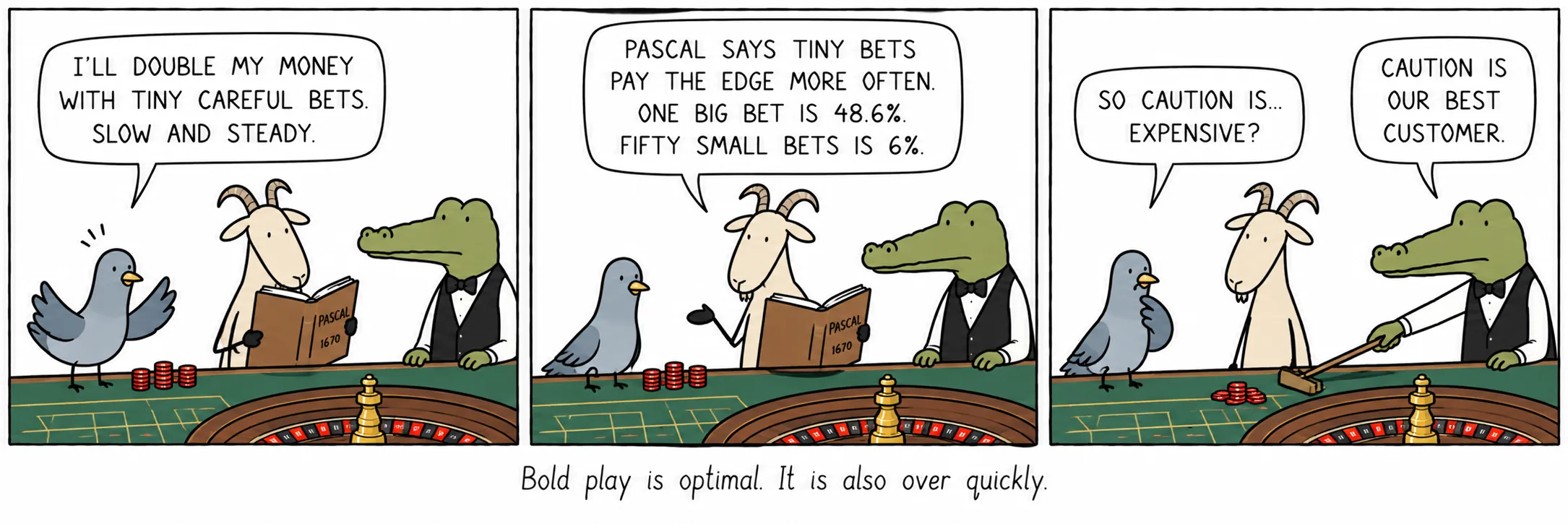
Bold play na di best. E also dey finish quick.
Sources
- Feller, W. An Introduction to Probability Theory and Its Applications, Vol. 1.
- Epstein, R. A. The Theory of Gambling and Statistical Logic, 2nd ed.
- Taylor, D. G. Games, Gambling, and Probability: An Introduction to Mathematics, 2nd ed.
- Carcavi, P. de. Letter to Huygens, 28 September 1656, about di problem wey Pascal give Fermat.
- Huygens, C. De Ratiociniis in Ludo Aleae.
- Ethier, S. N. The Doctrine of Chances: Probabilistic Aspects of Gambling.
- Reuters. “Briton bets it all on roulette spin, and wins.”
- Las Vegas Sun. “Man wagers life’s worth.”