Statistical Significance
“Significant” mean sey e no likely for fair wheel, no be “real” and no be “profitable”.

P-value of 0.05 mean sey fair wheel go produce pattern wey lopsided like dis one time for twenty. If you look twenty wheels, one go pass by accident.
Wetin P-Value Be
Di probabilitymathsProbabilityDi chance of one outcome, from 0 to 1 or from 0% to 100%. One number: 1/37 = 2.70%.Read di whole tin → to see deviation wey big at least like di one wey you see, if di wheel fair. Na statement about data under one assumption, no be about di wheel. P-valuelabp-valueDi probability to see deviation wey big reach di one wey you see or pass am, if di wheel dey fair.Read di whole tin → of 0.03 dey tok: fair wheel dey do dis 3% of di time. E no dey tok: 97% chance dey sey di wheel get bias. Di second statement go need to sabi how common biased wheelslabBiased wheelWheel wey get physical defect wey make some pockets come out pass 1/37. E rare, and you fit only find am with thousands of spins wey you record.Read di whole tin → be from di start, and for modern casino dem rare well well; so one single significant result dey far more likely to be luck pass to be real discovery.
Many Comparisons
Every test wey you run on fair wheel get 5% chance to pass for di 5% level. Test twenty wheels and one go pass. Test one wheel for twenty time windows and one go pass. Test one sample with 37 pocketequipmentPocketOne of di 37 small boxes wey get number for di rotor. Dem also dey call am: slot, cup.Read di whole tin → groupings, six sectorwheelSectorPockets wey follow each oda for one arc of di wheel, no be group for di layout.Read di whole tin → groupings and three colour groupings and sometin go pass. Di cure na to decide di test before you look di data, run am once, and confirm am on new data. Di scanning wey dey find “biased” wheel na usually di tin wey produce di result.
Significance Versus Size
Very big sample fit make small bias significant. Pocket wey dey hit for 1/36.5 instead of 1/37 na real defect wey go reach significance for few million spins, and e go still lose moni for 35 to 1 payoutmoniPayoutWetin bet wey win dey return, wey dem dey quote as “X to 1” on top di stake wey dem return.Read di whole tin →. Wetin matter for player na effect size: any pocket dey hit for 1/36 or better, and by how much? Di chi-square dey tell you about di wheel; na only di hit rate dey tell you about di bet.
Power
Di oda mistake na to miss bias wey dey there. With 1,000 spins, pocket for 1/30 (very big bias) dey get caught only about half of di time for di 5% level. Na size of di sample, no be sense, dey fix dis one. Di sample size page get di numbers.
Practical Standard
For bias claim to dey interesting: test wey you choose before, p < 0.01 instead of 0.05, to repeat am on independent sample wey get similar size, and estimated hit rate for di favoured pockets of 1/34 or better afta di repeat. Dat standard don happen only few times for di history of di game and never, as far as public records show, for modern wheel wey dem maintain.
Questions wey pipo dey ask
Na convention from di 1920s. Notin special dey about am; 0.01 na better bar when you dey scan many wheels.
E probably no dey give uniform results. E fit be dealer effect, recording mistake or data-entry problem. Do am again.
No. E dey tell you sey di distribution no correct. Sector analysis and effect size dey tell you where.
Play with Maths
Try dem by yourself first. Each solution dey folded; open am when you ready.
For one double-zerowheelZeroDi one green pocket wey no even-money, dozen or column bet dey cover; na im be di source of di house edge. Dem also dey call am: single zero, 0.Read di whole tin → wheel wey pipo report, di first dozenbetDozen1–12, 13–24 or 25–36, e dey pay 2:1.Read di whole tin → come out 742 times for 3,000 spins. How many standard deviationsmathsStandard deviationSquare root of variance; di normal distance between one result and di expected value.Read di whole tin → below di average be dat, and how often fair wheel go do am?
Show di solution
Answer About 8.1 standard deviations low. Fair wheel go do am about once for 3 × 10¹⁵ tries, wey mean never. Di answer wey dem publish with di question tok 11.75; we get 8.07.
Di first dozen get 12 out of di 38 pocketsequipmentPocketOne of di 37 small boxes wey get number for di rotor. Dem also dey call am: slot, cup.Read di whole tin →. For 3,000 spins e dey average 3,000 × 12/38 = 947.4 hits, with spread of √(3,000 × 12/38 × 26/38) = 25.5.
742 dey 205.4 below di average: 205.4/25.5 = 8.07 spreads.
Fair wheel dey fall three spreads short about once for 740 tries; eight spreads short, about once for 3 × 10¹⁵ (bell curve, one side). Even if you allow sey di reader notice di worst of three dozens, notin wey matter go change. Result like dis dey tok sey di wheel, or di count, no correct. For single-zero wheel, di same count go be 9.0 spreads low (average 973.0, spread 25.6).
Small laugh
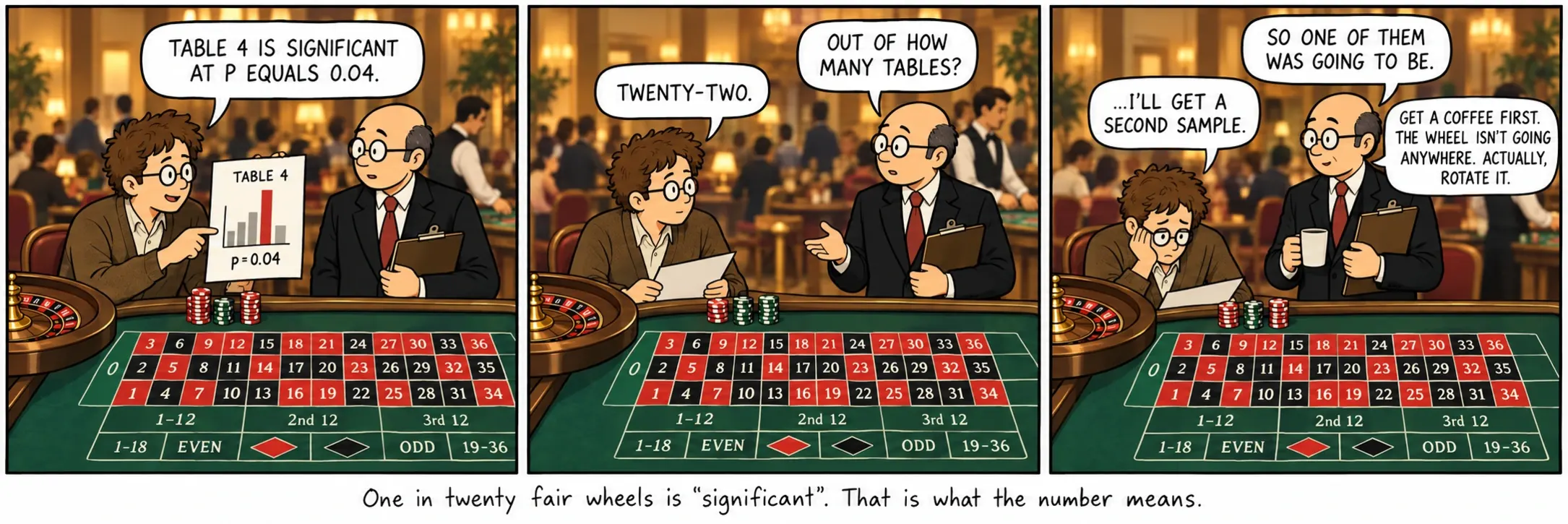
One out of twenty fair wheels dey “significant”. Na wetin di number mean be dat.
Sources
- Pearson, K. “On the criterion that a given system of deviations from the probable…”
- Feller, W. An Introduction to Probability Theory and Its Applications, Vol. 1.
- Wizard of Odds. “Ask the Wizard”, questions about roulette.