Fibonacci Strategy for Roulette
For di Fibonacci roulette strategy, stakes dey follow 1, 1, 2, 3, 5, 8, 13… Move one step forward afta loss, go back two afta win.
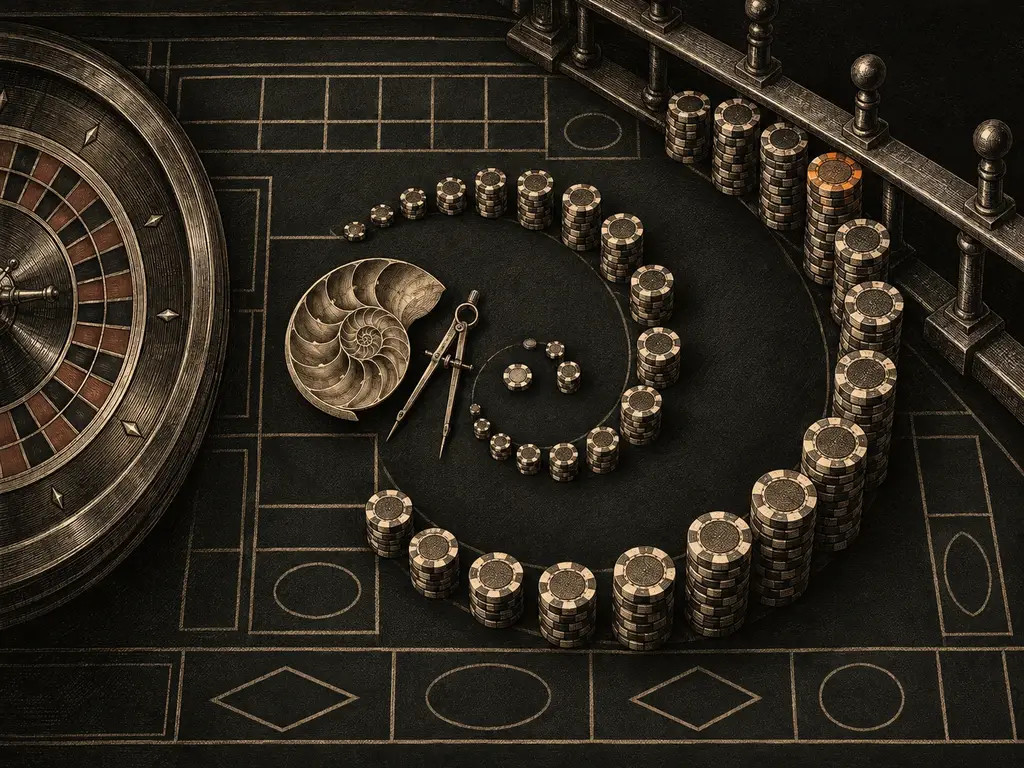
E no dey beat di wheel; no staking plan dey do am. E gentle pass Martingale, so e dey survive longer losing runs before e reach di limit, and e dey recover more slowly. Di expected loss na di same 2.70% of turnovermoniTurnoverDi total moni wey you bet for one session or one period, including winnings wey you bet again. Dem also dey call am: handle, action.Read di whole tin →.
How dem dey build di sequence
Each number na di sum of di two wey dey before am.
So afta 8 and 13, na 21 dey come.
Draw each number as square and di squares go fit each oda: every new one long reach di two before am wey you put side by side. Quarter circle across each square go join become spiral.
Waka through di sequence
Loss dey move one step go right. Win dey move two steps back.
Stakes and results dey in units of di base bet.
How di Fibonacci roulette system dey work?
Write down di FibonaccistrategyFibonacciProgression wey dey follow di sequence 1, 1, 2, 3, 5, 8, 13…: one step forward afta you lose, two steps back afta you win.Read di whole tin → numbers: 1, 1, 2, 3, 5, 8, 13, 21, 34, 55, 89, 144. Each one na di sum of di two wey dey before am. Start from di first one and bet dat number of unitsmoniUnitDi base stake wey system or player dey work with. Dem dey describe progressions in units so dat dem go fit work for any table.Read di whole tin →. If you lose, move one step to di right. If you win, move two steps to di left, or go back to di start if space no dey. Na di whole system be dat. Di table show wetin each step cost: run of losses wey di table limittableTable limitDi minimum and maximum bet wey dem allow. Na di maximum dey stop progressions wey dey double.Read di whole tin → or your bankrollmoniBankrollDi total moni wey you set aside for play. Bankroll management na to decide how much of am you go risk for each bet and for each session.Read di whole tin → stop go lose di sum of everytin wey you don stake reach dat point.
How session dey look?
Take $10 base and eight spins: L L W L L L W W. Di stakes go be 10, 10, 20 (win, back two, go step 1), 10, 10, 20, 30 (win, back two, go step 2), 10 (win, back to di start). Wetin you lose: 10 + 10 + 10 + 10 + 20 = 60. Wetin you win: 20 + 30 + 10 = 60. Five losses, three wins, and you dey level. Na dat one make pipo like di system. Di cost dey di same line: e take $120 of bets to reach dia, and every dollar wey you stake carry di house edgemathsHouse edgeDi part of each stake wey di casino dey keep for average: 2.70% for European roulette.Read di whole tin →.
Why step back two, and no be one?
Becos one win dey pay for exactly two losses. Each number na di sum of di two wey dey before am, so win at 5 units dey return di 2 and di 3 wey you lose just before. Think of staircase: one step up for every loss, two steps down for every win. Di step wey you stand on na your debt. For step 5 you dey 7 units down, for step 8 you dey 33 down, and when you come back for di first step you dey exactly level. Profit dey come only from wins for di first step, one unit at a time.
With wins wey almost reach di number of losses, two steps for one sound like better deal, and most of di time di staircase dey bring you back down. Di catch na sey di steps dey tall pass as you dey climb. Ten wins for di first step dey bring 10 units. Three losses for steps 6, 7 and 8 cost 8 + 13 + 21 = 42.
- p10 −$500
- p25 −$500
- median −$500
- p75 +$250
- p90 +$920
Di Fibonacci system dey work?
No. No be as way to come out with profit. Di calculation na di same as for every system: each bet dey lose 1/37 of im stake for average, so di whole sequence dey lose 1/37 of everytin wey you bet. To use di Fibonacci sequence for roulette no dey change dat one, becos di wheel dey pay di same odds no matter how big di chipmoniChipToken wey stand for one fixed amount, wey you put on top di layout to make bet. Dem also dey call am: check.Read di whole tin → be. Fibonacci stakes dey move up, so e dey bet more for each spin pass flat bettingstrategyFlat bettingTo bet di same amount every spin. Na di baseline wey dem dey compare every progression with.Read di whole tin →, and im expected lossmathsExpected lossExpected value times di total moni wey you bet; di average amount wey you go lose for one session or one period.Read di whole tin → for each session high pass. MartingalestrategyMartingaleProgression wey dey double di bet afta every loss. Check di Strategy section to see wetin e dey do and wetin e no dey do.Read di whole tin → dey bet still more, and e dey lose more.
E safe pass Martingale?
E slow pass, and dat one no be di same tin. Fibonacci stakes dey grow by about 1.6× for each step instead of 2×, so you go reach $500 limit afta about ten losses wey follow each oda from $10 base instead of six. Dat one make di cliff rare pass: ten even-money losses wey follow each oda na (19/37)¹⁰ ≈ 0.13%, against (19/37)⁶ ≈ 1.8% for six. But di cliff high pass too, becos you don stake more on di way, and one single win no fit undo am.
Where di numbers come from?
From one puzzle about rabbits. Leonardo of Pisa, wey pipo later call Fibonacci, put am for im Liber Abaci of 1202: start with one pair, make every pair produce new pair every month from im second month go, and count di pairs. Di answer na 1, 2, 3, 5, 8, 13. No be him first find di rule. Indian scholars of verse rhythm don write am down before: Singh (1985) trace am go Virahanka, between 600 and 800, and then go Gopala and Hemachandra.
No one of dem get wheel for mind. Di sources wey we use for here no tok who first stake moni by di sequence. Wetin dem show na sey im arithmetic and di arithmetic of roulette no dey ever meet: one dey tok how di stakes dey grow, di oda one dey tok wetin every stake dey return.

How much you go lose afta run of losses?
Two identities make di table wey dey up easy to check. Afta n losses wey follow each oda, di total wey you lose na di (n + 2)th Fibonacci number minus 1, wey give 1, 2, 4, 7, 12, 20 and so on, and di next stake na di (n + 1)th Fibonacci number. Bollman (2021) prove di same result by induction for sequence wey start 1, 2, 3, wey shift each number one place. For 500-unit limit from 1-unit start, Martingale no fit put im 10th bet, 512 units. Fibonacci fit put im 14th, 377 units, but e no fit put im 15th, 610.
Wetin dey change for dozen or column?
For dozenbetDozen1–12, 13–24 or 25–36, e dey pay 2:1.Read di whole tin → or columnbetColumnTwelve numbers for one column of di layout wey stand from up to down, e dey pay 2:1.Read di whole tin →, wey dey pay 2 to 1, you no need di step back. Win at stake F dey pay 2F, wey always pass everytin wey you lose before am, so every win dey end di sequence with profit. Di price na sey dozen dey win only 12 times in 37, so long losing runs dey happen far more: fourteen dozen losses wey follow each oda dey happen about once in 242 tries, against about once in 11,000 for redbetRedEven-money bet on di 18 red numbers. For French: rouge.Read di whole tin →.
Wetin if you stop only afta two wins wey follow each oda?
Anoda type dey move one step forward afta every spin, win or lose, and e dey stop only afta two wins wey follow each oda. With n losses before di two wins, di profit na di (n + 1)th Fibonacci number plus 1: e small when di wins come early, e big pass when dem come late, and you win am with stakes wey don grow to match. Two wins wey come early dey always come with small stakes; di one wey come late fit need big bet exactly for di moment wey di session don go worst.
Simulator · Fibonacci
2,000 sessions of even-money bets from $1,000 bankroll.
Base bet $10 · table limit $500 · 100 spins for each session
How often losing streak dey come
Even-money bet for single-zero wheel dey lose 19 spins out of 37. Each row na di chance sey one particular run of spins go lose finish, and how much Fibonacci player, wey dey move one step for di sequence afta every loss, don lose by dat time.
| losses wey follow each oda | chance | about 1 for | wetin you don lose so far | di next bet |
|---|---|---|---|---|
| 1 | 51.4% | 2 | $1 | $1 |
| 2 | 26.4% | 4 | $2 | $2 |
| 3 | 13.5% | 7 | $4 | $3 |
| 4 | 7.0% | 14 | $7 | $5 |
| 5 | 3.6% | 28 | $12 | $8 |
| 6 | 1.8% | 55 | $20 | $13 |
| 7 | 0.94% | 106 | $33 | $21 |
| 8 | 0.48% | 207 | $54 | $34 |
| 9 | 0.25% | 403 | $88 | $55 |
| 10 | 0.13% | 784 | $143 | $89 |
| 11 | 0.065% | 1527 | $232 | $144 |
| 12 | 0.034% | 2974 | $376 | $233 |
| 13 | 0.017% | 5792 | $609 | $377 |
| 14 | 0.0089% | 11279 | $986 | $610 |
| 15 | 0.0046% | 21965 | $1,596 | $987 |
Di chance na 19/37 wey you multiply by imself once for every loss, counting from one particular spin. Long session get plenty spins where dat kind run fit start, so for one evening e dey happen more often well well pass wetin one row show.
Questions wey pipo dey ask
Yes: forward afta win, back afta loss. E dey behave like ParolistrategyParoliPositive progression: double afta you win, start again afta you lose or afta three wins one afta di oda. Dem also dey call am: reverse Martingale.Read di whole tin → wey slow pass.
Play with Maths
Try dem by yourself first. Each solution dey folded; open am when you ready.
Play di type wey dey move one step for di sequence afta every spin, win or lose, and e dey stop afta two wins wey follow each oda: stakes 1, 1, 2, 3, 5, 8 and so on. Di first fourteen results na W L W L L L W L L L W L L W. Where you dey now, and wetin be di next bet?
Show di solution
Answer You don lose 22 unitsmoniUnitDi base stake wey system or player dey work with. Dem dey describe progressions in units so dat dem go fit work for any table.Read di whole tin →. Di next bet na 610 units, and one win go end di session with 588 profit.
Di stakes na di first fourteen FibonaccistrategyFibonacciProgression wey dey follow di sequence 1, 1, 2, 3, 5, 8, 13…: one step forward afta you lose, two steps back afta you win.Read di whole tin → numbers: 1, 1, 2, 3, 5, 8, 13, 21, 34, 55, 89, 144, 233 and 377. Add di wins and remove di losses: +1 −1 +2 −3 −5 −8 +13 −21 −34 −55 +89 −144 −233 +377 = −22.
Di last result na win, so one more win go end am. Di next stake na 610: win go leave +588, loss go leave −632 and next stake of 987.
Di type dey always end with profit, but here e need bet of 610 units to do am. Under di usual rules, two steps back afta win, di same fourteen results go leave you only 1 unit down with next bet of 2. Bollman (2021), wey start di sequence for 1, 2, 3, get 1 down and next bet of 3. Di usual rules dey lose less here becos each win dey pull di stakes back down.
spinstakeresulttotal so far11W+121L032W+243L−155L−668L−14713W−1821L−22934L−561055L−1111189W−2212144L−16613233L−39914377W−22For di same type, why n losses wey two wins follow dey always leave profit of di (n + 1)th Fibonacci number plus 1?
Show di solution
Answer Di n losses dey add up to di (n + 2)th Fibonacci number minus 1, and di two wins na di next two numbers, wey togeda pass am by di (n + 1)th number plus 1.
Write F₁, F₂, F₃ … for 1, 1, 2, 3, 5 … Each number na di sum of di two wey dey before am.
Di losses: F₁ + F₂ + … + Fₙ. Add 1 to dat sum, write am as F₂, and e go fold up: F₂ + F₁ = F₃, then F₃ + F₂ = F₄, and so on, until di whole sum na Fₙ₊₂. So di losses total Fₙ₊₂ − 1.
Di wins na di next two stakes, Fₙ₊₁ and Fₙ₊₂. Profit: Fₙ₊₁ + Fₙ₊₂ − (Fₙ₊₂ − 1) = Fₙ₊₁ + 1. With four losses, na F₅ + 1 = 6 units.
Small laugh
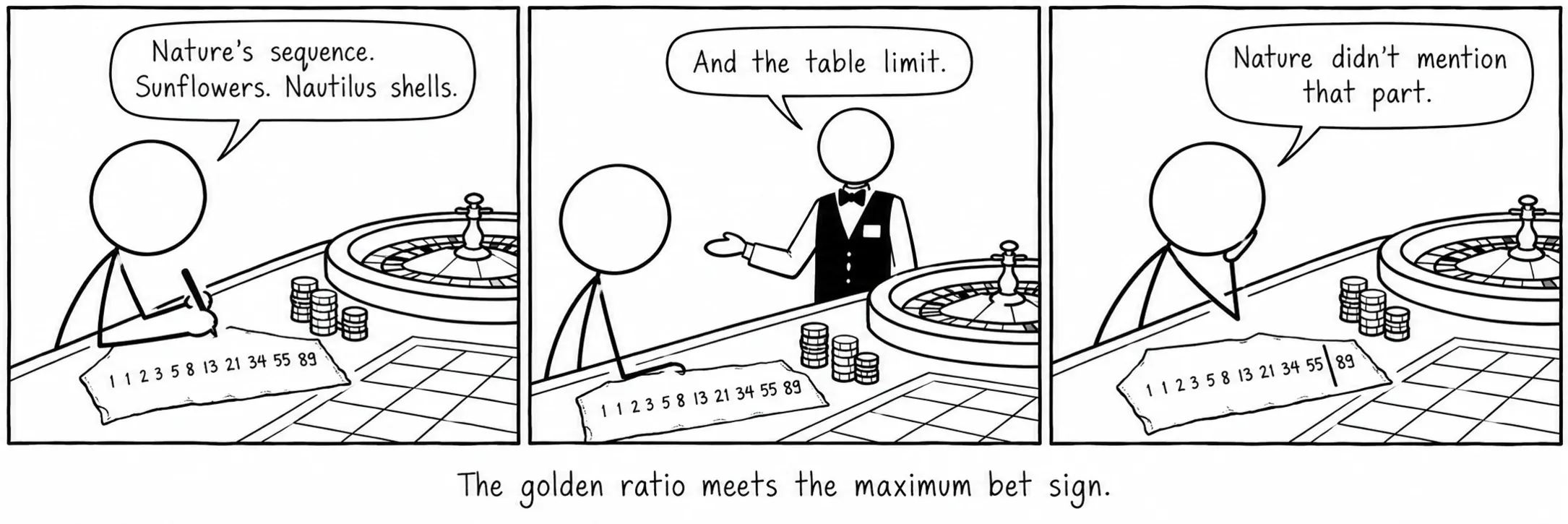
Di golden ratio meet di sign of di maximum bet.
Sources
- RouletteDoc. How di strategy dey work, with examples.
- Roulette77. How di strategy dey work, with examples.
- Ethier, S. N. The Doctrine of Chances: Probabilistic Aspects of Gambling.
- Epstein, R. A. The Theory of Gambling and Statistical Logic, 2nd ed.
- Bollman, M. Mathematics of the Big Four Casino Table Games: Blackjack, Baccarat, Craps, & Roulette.
- Sigler, L. E. Fibonacci’s Liber Abaci: A Translation into Modern English of Leonardo Pisano’s Book of Calculation.
- Singh, P. The so-called Fibonacci numbers in ancient and medieval India.